
Financing carbon capture, usage and storage: The case for extended producer responsibility
Article
The government has run out of road on funding infrastructure through energy bills.
There is a trade-off at the heart of the government's energy and economic policies. The government wants to respond to the public’s concern over rising costs, but has limited fiscal space. At the same time, the UK needs to invest in its old and failing infrastructure and support new dynamic industries to grow – but this also costs money.
Traditionally, government has funded energy infrastructure through bills because they are broad-based (nearly everyone uses electricity). Private investors saw bill funding as a more stable mechanism, less liable to political machinations, and were therefore willing to support with cheap finance. However, bill funding is regressive - the poorest pay proportionally the most. Government never stopped to ask whether this bill payer funding model was best for consumers.
Many clean energy policies funded by bills have been a good investment for the consumer. Contracts for difference for renewable energy have lowered bills relative to the counterfactual; the last offshore wind procurement round is expected to lower bills by over £1 billion, even including the cost of subsidy. But other types of infrastructure have less direct consumer benefit. Carbon capture, usage and storage (CCUS) is a prime example – it has benefits, but not to the cost of bills today. With cost of living and high energy bills remaining top public concerns, government needs to rethink how to fund infrastructure and growth industries, and who bears the cost.
This rethink can no longer wait. The 2025 Spending Review's £9.4 billion CCUS allocation always sat inside a constrained fiscal envelope, and that envelope has recently tightened. The current Defence Investment Plan requires DESNZ to find a further £2 billion of savings by 2030, with CCUS reportedly one of the areas in the Treasury's sights. With CCUS now competing directly with the government's declared first fiscal priority, the case for a funding model that isn't reliant on subsidy has never been stronger.
CCUS will be important infrastructure for growth and climate
Despite some scepticism from climate advocates who worry about CCUS’s technological immaturity and the risk of subsidising incumbent fossil fuel interests, CCUS features in virtually every credible net zero pathway. The state's role is to spread risk across technologies and enable innovation. Dismissing carbon removal as unproven is no different to dismissing wind or solar a generation ago.
CCUS is an industrial strategy ‘high potential sector’ and government and politicians back it for a number of reasons. The UK has a potential comparative advantage in manufacturing constituent CCUS parts for exports like condensers or piping. It also has significant service growth potential, for example through engineering consultancy.
While electrification is the best fix for most emissions, many sectors in the UK’s industrial clusters are still reliant on fossil fuels and therefore CCUS. Some industries, such as cement, cannot be decarbonised through electrification as emissions come from the chemical process regardless of the energy source used to heat the materials. As the international price of carbon rises, CCUS can help keep these industries competitive.
These hard-to-abate industries are highly concentrated in specific locations. For example, Derbyshire and Staffordshire account for 40 per cent of the country’s production of cement and lime. Although CCUS is a relatively low productivity technology on its own, it could help protect competitiveness and avoid potential job losses in these regions.
CCUS is also a strategic area for UK-EU cooperation. The UK holds approximately a quarter of Europe's subsurface carbon storage capacity, giving it the potential to play a large structural role in European decarbonisation. However, the UK has been absent from recent Northern European bilateral agreements on CO2 trade, and without progress risks falling behind countries like Norway, wasting a naturally advantageous position by not securing similar agreements despite its well-positioned geology.
The wrong people are bearing the burden for funding CCUS
The government has committed approximately £22 billion to CCUS over 25 years – a change from the inconsistency of previous administrations (figure 1). Funding is structured across a variety of mechanisms, including:
- Power carbon capture supported through dispatchable power agreements, funded by a levy on electricity bills, roughly £5 for the average user.
- Industrial and waste carbon capture incentivised through the UK Emissions Trading Scheme and supported through general taxation with carbon contracts for difference.
- Transport and storage infrastructure funded through the Regulatory Investment (TRI) model with public funds topping up returns to agreed rates. The lower the performance the higher the subsidy.
Figure 1: The government has committed approximately £22 billion to CCUS over 25 years
Red= Labour administration, blue = Conservative administration, arrows indicate increase or decrease in funding, or no changeSource: Author's analysis
An extended producer responsibility (EPR) framework addresses this unfair burden by broadening the obligation beyond industrial emitters to the organisations supplying their fuel. With an upstream carbon management system, such as a carbon takeback obligation, producers would be required to ensure that a defined and rising proportion of the carbon embedded in their fuels is permanently stored.
Figure 2: A carbon takeback obligation improves who funds CCUS infrastructure
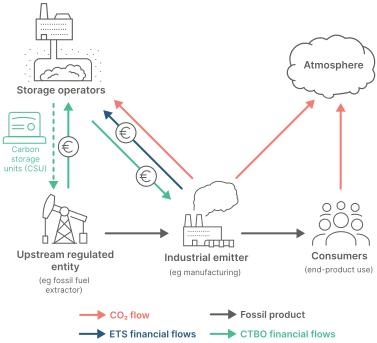
Source: Carbon Balance Initiative
The current model treats taxpayers and industrial emitters as the primary obligated party, yet they are removed from the source of the problem. Fossil fuel producers determine the volume of carbon that enters the economy and it is their products that create the need to capture and store emissions.
Extending the obligation upstream distributes costs more fairly across the value chain. A broader base of obligation means a lower marginal burden at each point, reducing the pressure that a narrowly concentrated cost structure generates. Additionally, by making the cost of carbon storage a condition of bringing fossil fuels to market, EPR ensures that the price of those fuels more accurately reflects their true cost. This further incentivises innovation to move away from these fuels altogether.
This approach is not without precedent. EPR frameworks have already been implemented in waste management in the EU and UK. While the concept of applying EPR to carbon emissions is newer, we are starting to see movement towards this type of thinking. Canadian prime minister Mark Carney recently negotiated an arrangement with oil and gas producers in Alberta requiring investment in carbon storage as a condition of continued extraction rights. Additionally, the EU's 2024 Net Zero Industry Act obliges fossil fuel companies to invest in storage capacity as a proportion of fuel they bring to market.
Most of the UK's carbon storage potential is only realisable if European industrial emitters can transport CO2 to UK sites and regulatory divergence would undermine that prospect. Treating CCUS as a core element of the UK–EU cooperation agenda is therefore strategically important and an EPR approach in the UK would move towards alignment with this framework.
North Sea licensing offers an opportunity to implement the principle
Government will soon decide the fates of the Jackdaw and Rosebank gas and oil fields. Consents for both fields were previously quashed by the courts for failing to account for the climate impact of the fuel once burned. An EPR-style approach would reframe the decision. These licenses could be made conditional on developers storing a proportion of CO2 from the fuels produced. They could do this themselves or pay a small levy which government would use to cover the cost of its CCUS investment, freeing up fiscal space for other investments like electrification.
Importantly, because UK gas and electricity prices are set by the global wholesale gas market, this obligation would have no effect on domestic consumer prices. Similarly, it is not of a size that would impede investment, as a fraction of the existing fiscal regime. Applied to a field the size of Rosebank, a net zero-aligned obligation would peak at around 2.5 million tonnes of CO2 a year, roughly equivalent to all the capture projects that have so far reached final investment decision within the HyNet cluster combined.
If government is going to approve these fields a CBTO could go someway to mitigating its impact, reducing emissions, channeling capital into the infrastructure that will be needed to replace oil and gas jobs as the North Sea basin winds down, and, most importantly, freeing up government and billpayer capital for the projects that really reduce bills – clean electrification.
Related items

The wiring behind rewiring the state: Energy devolution in England
How the government can give local leaders the opportunities to lead energy transformation locally.
The Europe agenda: Energy and climate
A redefined relationship with Europe is the most direct path to the UK's climate and energy goals.
Partner to scale: How international collaboration can enable the green transition
Scaling clean industrial technologies requires a shift from fragmented national strategies to targeted, durable international cooperation.