
Joining forces: A better strategy for defence spending with allies
Article
Andy Burnham has made the case that national security and rebuilding Britain’s hard power will be priorities for his government.
Appointing John Healey as chancellor signals this priority. Healey resigned as defence secretary in June over shortfalls in funding the defence investment plan (DIP). He now controls the spending levers he argued were holding it back.
But what levers should he pull, and to what end? Defence funding needs to be affordable and offer value for money, but it also needs to enhance Britain’s security — and to deliver on Burnham’s promises of “reindustrialisation through defence”.
Meeting the immediate defence funding gap – the ‘unfunded’ element of the DIP – requires little. Healey and new defence secretary Wes Streeting can find the remaining £1 billion a year without major policy change, a small share of the ‘headroom’ held against the fiscal rules.
However, Healey was “certain” in June that we need an acceleration to 3 per cent of GDP by 2030. Getting there would mean around £13 billion extra each year in today’s prices. This requires a robust strategy.
International partnerships are key. Defence is more effective, better value and more supportive of industrial development if the UK and its allies plan and buy together, and our analysis shows this could free up to £3.4 billion of additional room to borrow for investment. Spending without a clear plan risks negative impacts, including inflation.
To meet our Nato commitments, the new defence secretary and chancellor will still face hard decisions about funding
However, while valuable, cooperation will not deliver £13 billion a year alone. To meet our Nato commitments, the new defence secretary and chancellor will still face hard decisions about funding.
Warfare is changing quickly, and the UK needs to keep up
The world that shaped past decades of defence thinking has gone. Fundamentally, we can no longer rely on US security guarantees. The UK must take greater responsibility for its own security, in the alliances we form and the defence industries we rely on.
Warfare itself has also changed. In Ukraine and Iran, we have seen drones make troops and equipment easier to detect, cheap systems destroy expensive kit, and rapid innovation determine who gains ground. War no longer happens ‘elsewhere’. Russia is carrying out daily hostile activity against the UK and Europe, from cyberattacks to pressure on critical infrastructure.
A response is already underway. Countries are grouping together outside Nato and rethinking how they defend and spend.[1] What should UK priorities be?
Fund the defence investment plan
First, government should commit to fund the DIP, and move on. While Burnham’s government must find more resources in the 2026 budget, reports of a fiscal ‘black hole’ are exaggerated.
The ‘unfunded’ gap is just £0.9 billion in 2029/30 when the fiscal rules bite – against a headroom ‘buffer’ of more than £20 billion. Decisions to eat into headroom deserve caution, but nobody needs to tear up the books to meet the existing DIP.
Work forwards from the threat, not backwards from the target
Second, spending commitments need to increase our security. Nato members agreed to spend 3.5 per cent of GDP on core defence by 2035 and Starmer had aimed for 3 per cent by the next parliament.
A spending target is crude but potentially valuable, driving government towards a priority while signalling commitment to partners. But targets can be gamed. Canada moved its coast guard mandate to the Department of National Defence, reclassifying existing spending as Nato expenditure without changing its defence.
The UK’s own aid target ended up covering a much wider range of activities that didn’t necessarily aid development. Spending must serve the goal it is meant to support, or British citizens pay to hit a number rather than get the outcome they were promised.
Government is right to examine ‘defence-specific’ funding solutions.
If defence spending has to rise, how do we pay for it? Borrowing will almost certainly be part of the answer – so it is worth asking not just how much the government borrows, but how well.
Several ‘defence-specific’ options are now being floated, from savings bonds to a shared defence bank.
Table 1: Options for defence borrowing
Source: Author's analysis
Defence bonds can help at the margins, but aren’t a funding strategy
Selling bonds to the public can raise morale, but recent experience suggests they won’t raise enough. They mostly reshuffle existing savings, offering one-off financing against an ongoing cost. Even wartime campaigns fell short—the 1914 War Loan missed two-thirds of its target—while recent Green Savings Bonds raised just £1.8 billion.[2] Bonds sold to the market rather than to households are largely a labelling exercise: most economists agree this wouldn’t be cheaper than normal borrowing.
Multinational defence banks look more promising, at least in terms of industrial capability
Members provide paid-in capital (the entry ticket) and promise ‘callable capital’ if the bank suffers losses.[3] The bank borrows against that backing and provides loans, guarantees and other instruments to member governments and firms in the defence supply chain. The most publicly developed example is the Canada-led Defence, Security and Resilience Bank (DSRB), now in development. Its final membership, credit rating and operating model are not yet settled.
The strongest case for a defence bank is its potential to unlock private lending to members’ defence industries (eg munitions factories and drone firms). On the DSRB’s own figures, a £1 billion stake could support between £5 and £8 billion of financing across member countries, if the bank’s rating and capital structure permit. Its proposed model would direct finance to member countries only, so staying out of the DSRB would leave British firms unable to directly benefit.
In the UK, a significant portion of the money we’ve spent on defence has been wiped out by higher costs
Across Europe, including in Britain, smaller defence firms can struggle to attract investment and secure loans, preventing them from scaling to meet defence needs. Some support is provided via the British Business Bank, which has expanded its equity support for defence firms, while its wider loan and guarantee schemes are open to the sector.[4] However, a DSRB could add a multinational layer by sharing risk through a member-backed institution, guaranteeing commercial lending and supporting larger or cross-border projects serving several allies. This could make genuinely cross-border defence supply chains easier to finance than through national schemes alone.
To the extent that multinational defence banks genuinely build additional industrial capacity, they can also help limit defence inflation. Without more capacity, higher spending can simply bid up prices. The scale of the pressure is clear: standard ammunition costs 300–600 per cent more than in 2021. In the UK, a significant portion of the money we’ve spent on defence has been wiped out by higher costs. Relying on American factories does not strengthen the UK economy or build the independent capabilities we need.
A defence bank like the DSRB would have little direct effect on the UK’s fiscal position for the following reasons.
- The entry cost barely touches the UK’s fiscal rules, which measure debt as net financial liabilities; paid-in capital counts as a financial asset. Borrowing £1 billion to enter (estimated by Alex Baker MP) adds a liability but a matching asset, leaving the rule broadly unchanged – even if the headline borrowing figure still moves.
- The impact on the UK’s own borrowing cost is also likely to be limited. Governments borrowing through the bank would pay its funding rate plus a margin. Whether that would beat gilt financing depends on the bank’s eventual membership, credit rating and operating costs, and cannot be assumed. Other multilateral institutions have been more expensive for the UK in the past, and most DSRB members are less creditworthy than the UK.[5]
More ambitious solutions could offer genuine savings and fiscal flexibility
The UK’s planned multilateral defence mechanism (MDM) is a £400 million commitment launching in 2027, with the Netherlands, Finland and Poland. As currently proposed, the DSRB focuses primarily on crowding in private capital, while the MDM puts joint procurement and “stockpiling on members’ behalf” as a core aim. Nothing stops the UK pursuing the MDM whilst in the DSRB, or bringing them together. The strongest model would combine finance for supply with predictable, pooled demand.
Joint procurement combines orders, cutting prices through scale and less duplication. Europe fields around 178 major weapon systems to America's 30 – including 17 types of main battle tank against a single US model. A wider, international market can increase competition and help hold down defence inflation. Joint procurement could, on indicative estimates, cut equipment unit costs by around 20 per cent (based on EPRS and McKinsey estimates).
Shared stockpiling could also help with the fiscal rules. If the MDM bought and held part of Britain’s £11.1 billion munitions programme until needed, UK borrowing would appear under the debt rule only when stocks were drawn down (requires MDM ownership and UK payment only on drawdown).
On current plans, stockpiling could defer up to £2.5 billion of UK borrowing, while joint procurement could reduce equipment costs by around £0.9 billion. The combined gain is up to £3.4 billion under the fiscal rules, rising to around £4.5 billion if spending accelerates to 3 per cent of GDP by 2029/30.
Figure 1: Joint procurement and shared stockpiling could free up to £4.5 billion under the debt rule
Extra room to borrow before the debt rule breaks, 2029/30 (£bn)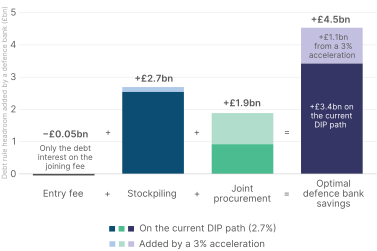
Source: IPPR modelling
Joint procurement is a genuine saving: the equipment costs less, provided members buy and plan together well. Stockpiling is different, and doesn’t save money – Britain still pays when it draws the stock down. What it buys is time, and the chance to build stocks now while the threat is immediate.
There are problems to resolve. A shared stockpile needs agreed ownership and drawdown rules, as well as warehouses, security, maintenance and administration costs. These costs can reduce how much the mechanism can hold, and so the fiscal space created. The accounting and credit-rating treatment would need testing, and joint procurement requires an integrated defence plan – agreeing threats, equipment and specifications before a common order. The UK should keep developing the ideas, but not bank the savings yet.
Partnerships are the right way forward – but we still need to face up to the defence bill
The best outcome would be to bring the MDM and DSRB together in a single vehicle spanning the UK, European partners and Canada. A broader coalition creates more scope to bring orders together, lower costs and generate fiscal savings on defence equipment. It also reinforces the defence alliances we need for the future, reducing our reliance on the US.
That may not be possible immediately. In that case, Streeting should still seek founding membership of the DSRB and push for alignment with the MDM, rather than wait for a perfect solution. Membership would not close the defence funding gap, but it could help expand the industrial base needed to turn higher spending into greater capability with allies. Joining at the outset would also allow Britain to shape the bank’s rules rather than inherit them.
The UK can spend more intelligently, but it cannot avoid the underlying fiscal choice
At the same time, Britain should press ahead through the MDM – or a merged vehicle – with joint procurement and genuinely multilateral stockpiling. Together, these could create up to £3.4 billion of additional headroom.
Cooperation can make defence stronger, cheaper and easier to finance. It cannot make it free. Borrowing can spread the cost of factories, infrastructure and equipment over time, and well-targeted investment may support growth. But a permanently larger defence budget also means higher ongoing costs for soldiers, training and maintenance. Those costs must ultimately be met through higher revenues or lower spending elsewhere.
The UK can spend more intelligently, but it cannot avoid the underlying fiscal choice. Creative defence financing must sit alongside an unglamorous long-term tax and spending plan.
[1] Examples include E3, JEF and the missile coalition.
[2] See: Ben Zaranko.
[3] Comparable banks have never called capital.
[4] See investments in defence firms Kraken and Hadean, and the Growth Guarantee Scheme.
[5] Examples include the World Bank, AIIB, African Development Bank and the EBRD. Of the nine countries currently committed to the DSRB, six S&P credit ratings are below the UK’s AA rating.
Related items

New world, new relationship: Our future with Europe
Britain’s assumptions about its place in the world no longer hold, upturned by Russian aggression, American unreliability and Chinese coercion.
A durable majority?: How public opinion on the EU performs under pressure
A decade on from Brexit, Andy Burnham has signalled that a reassessment of the UK’s relationship with the EU might be around the corner.
Aligning for growth? The benefits of an EU-UK mutual recognition agreement
Scoping the potential next frontier of a deepening relationship between the UK and the EU.