The government is about to host a ‘Global Partnership Conference’ – should it even bother?
Article
Tomorrow, the government is hosting the Global Partnership Conference in East London.
Co-hosted with South Africa, the summit will bring together ministers, government officials, business leaders, and civil society representatives from around the world to discuss the future of international cooperation.
It is an attempt to signal that the UK remains committed to international collaboration at a moment when US isolationism is growing and the rules-based order is under strain.
And in particular it is an attempt to reposition the UK’s ‘development’ work after years of turbulence. Successive cuts to the aid budget have thrown the narrative around UK development project into disarray. If we don’t give 0.7 per cent of GNI, what are we doing? And more fundamentally, why?
Because truthfully, at times, the UK’s development work felt like a spending target trailing a narrative. And that narrative was often in flux, shapeshifting to try to reflect the latest Whitehall preoccupations. This meant that rather than communicating compelling purpose, development could be tagged as aimless benevolence. In a more brutal geopolitical and fiscal era, it shouldn’t be surprising that cuts followed.
Successive cuts to the aid budget have thrown the narrative around UK development project into disarray
But this is vital work. Among other things, development responds to an essential truth - the UK and partner countries are deeply interlinked. Their stability and prosperity underpins our own. And not in an esoteric sense, but intimately, with impacts on British people’s daily lives.
Development matters. This conference will fail if it proclaims that without believing it. But it could be a valuable success if it is part of a process of Britain gaining a new view of why development matters – to us.
Development matters: Food
One example suffices: The UK is struggling with a cost of living crisis, and at the heart of that is the cost of food.
What’s the link with development? Our analysis shows that 84 per cent of the value in agricultural products purchased in the UK, comes from abroad.
We built this system in more stable times, and in many ways it worked for the UK.
What does that mean? Imagine a potato grown in the United Kingdom. That potato probably feels quite ‘British’, and quite insulated from international shocks. But to grow the potato, we might need fertilizer from Ukraine and machinery from China. Similarly, China and Ukraine will be reliant on other countries to help produce their fertilizer and agricultural machinery - the supply chain goes on and on. So most of the potato’s value will not be produced locally.
We built this system in more stable times, and in many ways it worked for the UK. For example, just prior to the Covid-19 pandemic (in 2018) British households spent the lowest proportion of their incomes, on average, on food and non alcoholic beverages compared to any country in the EU. Integrated supply chains are not a problem per se.
But it starts to become problematic in a more risky and unstable world. Our analysis (see figure 1) shows that of agricultural goods bought in the UK, over half (58 per cent) of their value comes from countries exposed to water stress or higher levels of political instability (we repeated our analysis for the manufactured food category and 45.9 per cent of the value-add came from vulnerable countries. The manufactured food category also includes beverages and tobacco). Those risks mean potential shocks to production, stoppages in trade, shortages – and further price rises.
Figure 1: The UK's agricultural supply chain is vulnerable
Irrigation water stress and political instability by UK agricultural partner, 2022 (normalised, 0-1; bubble size = import share)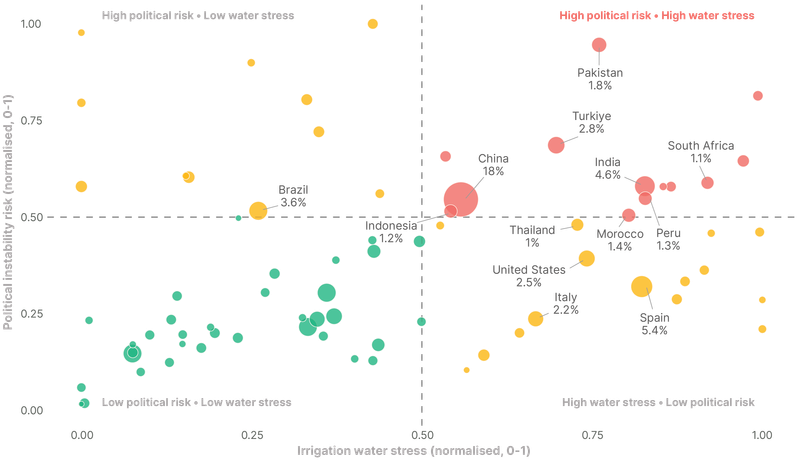
Source: IPPR analysis of OECD TiVA 2025, WRI Aqueduct 4.0 and World Bank governance indicators.
Note: Scores are normalised within the import partner set; colours indicate whether countries score high on both axes, high on one axis, or low on both.
Where are these risks located? Many are affecting countries that the UK considers critical development partners. Pakistan, South Africa, India, Morocco, Indonesia, Brazil and Thailand all jump out of the chart above. The UK has worked and continues to work intensively with these countries to combat these risks, supporting their climate resilience, and building economic and political stability. This is not necessarily with bilateral aid, but with a whole range of other tools such as lending through the World Bank and regional development banks, technical assistance on climate, finance and infrastructure, and many other interventions.
Not reflected in the chart, are smaller developing countries. Their role in the supply chain is usually to provide raw commodities, which have smaller amounts of value add than other products up the supply chain – wheat is certainly less valuable than flour. However, they can still have seismic effects on the goods we consume.
We need to prevent crises, rather than wait for them to wash up on our shores
Take cocoa: Ghana and Côte d’Ivoire together produce over 60 per cent of the world’s supply, and disruptions there ripple upwards through every tier of the chocolate and confectionery industry. In the last few years climate shocks in West Africa have contributed to a more than tripling of the world cocoa price, and an approximate 43 per cent increase in the price of chocolate in the UK.
When the farmers and smallholders at the bottom of these chains face climate shocks, conflict, or economic collapse, the consequences are felt in UK supermarkets long before policymakers have time to react. We need to prevent crises, rather than wait for them to wash up on our shores.
Investments in partner countries’ climate adaptation, conflict resolution and economic development are not aimless benevolent giving. They are interventions in supply chain resilience, in containing the UK’s cost of living, and in supporting British people’s ability to believe in a stable, affordable future.
Development matters? Other countries’ approaches
While the UK is only partway along the journey of accepting interconnectedness, other countries are further ahead. The global retrenchment from aid forced governments around the world to think afresh what international development is actually for in today's world – and a number decided that it was deeply relevant.
This isn’t just rhetoric. Germany aside, these countries have not cut their aid budgets
Italy, for example, launched the Mattei Plan for Africa in 2024, which channels climate finance and ODA into investments in skills, energy infrastructure, and food systems across the continent. Food and energy security were also at the heart of the Italian G7 presidency in 2024. Whatever one thinks of the wider politics, Meloni’s government has understood that it cannot manage its domestic priorities without genuine engagement with African partners.
Other countries too have seriously engaged with what a new approach might involve, and whether it has value. Denmark (A changing world: Partnerships in development (2025) and Africa’s century (2024)), Germany (Shaping the future together globally (2026)), and Norway (Project turning point) all share a common thread: an acknowledgement of the self interest – as well as the solidarity – reflected in development partnership.
This isn’t just rhetoric. Germany aside, these countries have not cut their aid budgets. While aid does not equal development, a government deciding that it wants to retain its aid budget in the face of global cutbacks suggests a genuine commitment to the work – a belief that there is something real at stake.
Deeds not words
At a time where the world feels even more uncertain than just a year ago, the Global Partnership Conference is a welcome signal that many actors, including the UK, believe international cooperation remains possible, even in a world of extractive transactionalism.
The moral case for development has not changed. The strategic case has never been stronger
But in this difficult world, signalling is not enough. Sustaining a policy, project or partnership over years - in the face of geopolitical and fiscal pressures - means believing that the project matters, that it will deliver essential outcomes. In our interconnected globe that means addressing vulnerabilities beyond our shores, to the benefit of our partner countries - and ourselves.
The moral case for development has not changed. The strategic case has never been stronger. The task now is to not just stand on a stage and say that, but to believe it, and to act accordingly.
Related items
New world, new relationship: Our future with Europe
Britain’s assumptions about its place in the world no longer hold, upturned by Russian aggression, American unreliability and Chinese coercion.
A durable majority?: How public opinion on the EU performs under pressure
A decade on from Brexit, Andy Burnham has signalled that a reassessment of the UK’s relationship with the EU might be around the corner.
Aligning for growth? The benefits of an EU-UK mutual recognition agreement
Scoping the potential next frontier of a deepening relationship between the UK and the EU.