
Windrush Day: The unfinished business of immigration reform
Article
Eight years after the Windrush scandal, its lessons remain highly relevant to debates about immigration policy today.
As we mark Windrush Day this year, it is an opportunity both to celebrate the immense contribution of the Windrush Generation and their descendants, and to reflect on what the scandal revealed about the consequences of getting immigration policy wrong.
The Windrush scandal first came to public attention in 2018, revealing that people with the right to live permanently in the UK were unfairly treated as illegal immigrants. This was due to a combination of factors. An act of Parliament in 1971 entitled many people from the commonwealth “the right of abode” in the UK, but the Home Office did not provide documentation proving their status, and record-keeping of this was inadequate. The hostile environment – a set of immigration policies introduced by successive governments to discourage people from entering the country illegally - meant that many wrongfully experienced the full force of immigration enforcement measures as a result.
The Windrush scandal was “foreseeable and avoidable”
Since then, the government has made progress in acknowledging and addressing the harms and injustices caused by the scandal, most notably by commissioning the Wendy Williams Lessons Learned review, establishing a compensation scheme to ensure those who suffered losses and hardships are adequately compensated, and appointing a Windrush Commissioner to be a trusted voice for victims and their families.
As Wendy Williams noted in her review, the Windrush scandal was “foreseeable and avoidable”. It was not the result of a single point of failure in immigration policy - it was the cumulative effect of complex immigration rules, poor record-keeping and, as she described as “the institutional ignorance and thoughtlessness towards the issue of race.”
Yet, the work remains unfinished. An evidence session held earlier this month by the public accounts committee (PAC) heard evidence on the operation of the Windrush compensation scheme, during which concerns were raised about its effectiveness and accessibility. Clive Foster, the Windrush Commissioner, highlighted that nearly six in ten compensation decisions resulted in no award, suggesting potential flaws in the scheme's design and delivery. He also noted that claimants found applying for the compensation exhausting and painful, particularly due to the burden of evidence placed on them. Campaigners continue to raise concerns about delays and the fact that some claimants have died before receiving compensation.
Home Office policy “is about people, and, whatever the objective, should be rooted in human dignity”
Wendy Williams stressed that Home Office policy “is about people, and, whatever the objective, should be rooted in human dignity”. This matters more than ever as we enter a new era of immigration policy, particularly in the context of the government’s plans on “earned settlement”. Under this proposal, the default qualifying period for indefinite leave to remain (ILR) would increase from five years to ten or 15 years, with individuals potentially able to shorten or extend the wait based on a range of criteria. As IPPR has previously argued, these reforms could fundamentally reshape pathways to settlement for hundreds of thousands of migrants.
The lessons of Windrush are particularly relevant in this debate. Many affected by the scandal believed their status in the UK was secure, only to find themselves unable to prove their rights when challenged by the state. Similar concerns have been raised about the proposed settlement reforms. By increasing the time people must navigate the immigration system and making the routes more conditional, there is a risk that this could create a population of people living in the UK who experience prolonged insecurity or fall out of status altogether. Without the right safeguards, the consequences may only become apparent years later, echoing the pattern of institutional failure that defined Windrush.
Our latest analysis of the earned settlement proposals suggests that some communities are expected to face longer waiting times for settlement compared to others. Estimates of the qualifying period for ILR under the earned settlement proposals for people granted skilled worker entry clearance visas in 2022-23 indicate that the majority of people from Africa and South Asia will wait 15 years to settle, while most people from North America and Europe will wait 5 years.
Figure 1: Estimated waiting period for ILR for people granted Skilled Worker entry clearance visas in 2022-23 by world region
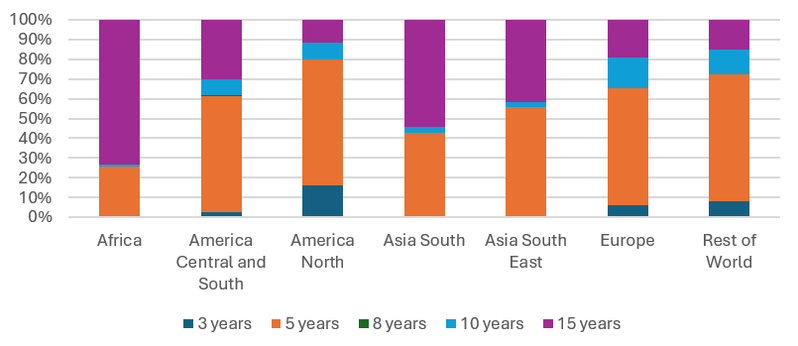
SOURCE: IPPR analysis of Home Office data. Calculations are based on allocating an estimated ILR qualifying period for each SOC code. This is in turn based on the skill level and median salary for the occupation (using certificate of sponsorship data obtained via FOI by Migration Observatory) adjusted for wage growth. Where salary data is missing for occupation codes, we instead use ASHE. We also factor in whether the occupation is a public service role and so eligible for a reduction in the qualifying period. Note that this data only covers the period 2022-23 due to the change in SOC codes in 2024; there may be a shift in patterns beyond this point as new restrictions were imposed and visa grants fell.
The Wendy Williams Review should remain central to the design of new policies in the Home Office. Its recommendations - to understand the historical context of immigration legislation, assess the potential impacts of reforms on different communities, and give greater consideration to the risks facing vulnerable groups - were intended not only to mitigate failures from the past but also to prevent similar injustices from emerging in the future.
In an increasingly polarised political climate, discussions on immigration can too often lose sight of the people directly affected by policy decisions. At a time when many migrants and racialised communities are feeling increasingly exposed to hostilities – particularly in light of recent riots – the principles at the heart of that review are as urgent as ever. The most meaningful way that the government can honour the Windrush Generation is to ensure that they are fairly compensated for the injustices they experienced, and to guarantee that the same mistakes are not repeated in future.