Press Story
- Quadrupling council populations while cutting councillor numbers risks leaving communities more distant from power unless action is taken
- Government must double down on devolution so communities have a say and a stake in decisions that shape everyday life
- IPPR North recommends ensuring “democracy within walking distance” by allowing communities to request powers from strategic authorities, giving them more control over their future
The government’s plan to scrap district councils in favour of unitary authorities risks moving local residents further from power unless action is taken to empower communities, warns a new report from IPPR North.
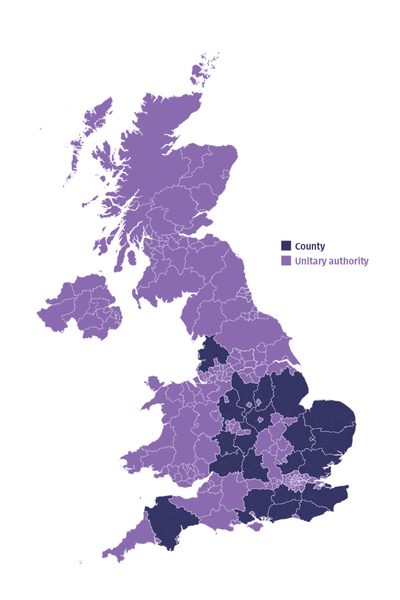
Local government reorganisation is once-in-a-generation opportunity to bring the relationship between councils and communities into the 21st century - if done well (see map in Notes below for councils facing reorganisation across England).
England already has some of the largest councils by population and the fewest councillors per resident in Europe, say IPPR North. The government’s plans to abolish district councils and create new, much larger unitary councils would increase the population per council size four‑fold, from the current average of 115,000 to a likely 500,000.
This would mean remaining elected representatives will be responsible for even more residents than they are today.
IPPR North say that government and local authorities should take action to use the ongoing process of reorganisation to revive democracy in local communities and shift power downwards by default.
Researchers looked at areas with strong, community‑led bodies, and saw major improvements after local people were empowered, with control over local social hubs and more involvement in local democracy. They make a strong positive case for new “hyperlocal” councils, as well as greater participation, in a move towards “democracy within walking distance.”
The think tank recommends the creation of community‑led neighbourhood boards, in which local people would have the powers to transform their local areas, giving them a real say in investment and decision making.
In the same way that mayors will have the right to request powers from central government, communities should have the right to request powers from all unitary and strategic authorities.
Government has already shown its commitment to investing in and renewing communities with its Pride in Place programme, the report says, but it is vital that democratic renewal also forms part of this agenda, giving real powers to the people in those places. Also, that Pride in Place reinforces the power-shift being made as part of the devolution agenda.
The report finds three ways the government and local authorities can use democratic innovation to make the most of this moment:
- Double down on devolution - give communities the right to request powers from unitary and strategic authorities
- Roll out community-led neighbourhood boards with a minimum 50 per cent representation by local community members
- Democracy within walking distance - offer innovative ways for citizens to participate in democracy at a “hyperlocal” level, such as participating in budgets and making decisions on how to improve their neighbourhoods
Researchers warn that if government truly wants devolution to be its flagship programme, it must make devolution mean something for people living in these communities - or risk squandering it all together.
IPPR North research fellow, Dr Ryan Swift says,
“Devolution across England represents a once in a generation opportunity to renew local democracy. There are fears that merging councils into larger unitary authorities could put this at risk.
“But if devolution and local government reorganisation is accompanied by a deliberate commitment to community-led, participatory governance it can become a catalyst for genuine community empowerment and local democratic renewal.
“There is no choice but for devolution to work.”
Jack Burkinshaw, chair of Brereton Big Local CIO, a community-led charity in a Staffordshire village, said:
“We’ve seen first-hand what can happen when communities are genuinely given a voice and the power to shape their own future.
“Being a locally trusted, community-led group has allowed us to listen carefully to what matters most to the people around us. That approach has helped shape a real sense of community spirit — not just in words, but in action. When residents feel heard and involved in decisions, they take pride and ownership in what’s being built together.
"Why should decisions impacting communities be made miles away by an officer that’s not aware of the challenges facing that community?”
ENDS
Dr Ryan Swift and Jack Burkinshaw are available for interview.
Contact:
Maeve Schaffer, media and communications for IPPR North, on 07585772633 or [email protected]
Notes:
IPPR North is the leading think-tank in the north of England, developing bold ideas for a stronger economy and prosperous places and people. For more information, visit ippr.org/north.
Map of county council areas, highlighted in dark blue, going through local government reorganisation process (Author’s analysis):