Press Story
- IPPR analysis exposes extent of supply chain risk: British share plummets when resellers of foreign tech and foreign-owned or staffed firms are removed
- US firms capture almost twice as much spending as other foreign suppliers
- Public sector spending on technology is heavily concentrated on just 150 large firms
- Researchers warn that building domestic capability not enough and urge ‘middle power coalition’ to avert US shut-out
- Darren Jones MP says: "We need to join with natural allies like France, Germany, Japan and Korea and make ourselves indispensable together."
Despite the UK having the one of the world’s most attractive technology and AI industries, our public sector is dependent on a small number of contractors, IPPR researchers warn, leaving critical infrastructure exposed to decisions taken in Washington.
Public sector spending on technology is heavily concentrated, according to analysis of UK government contracts by the think tank, with four fifths of spending going to just 150 firms.
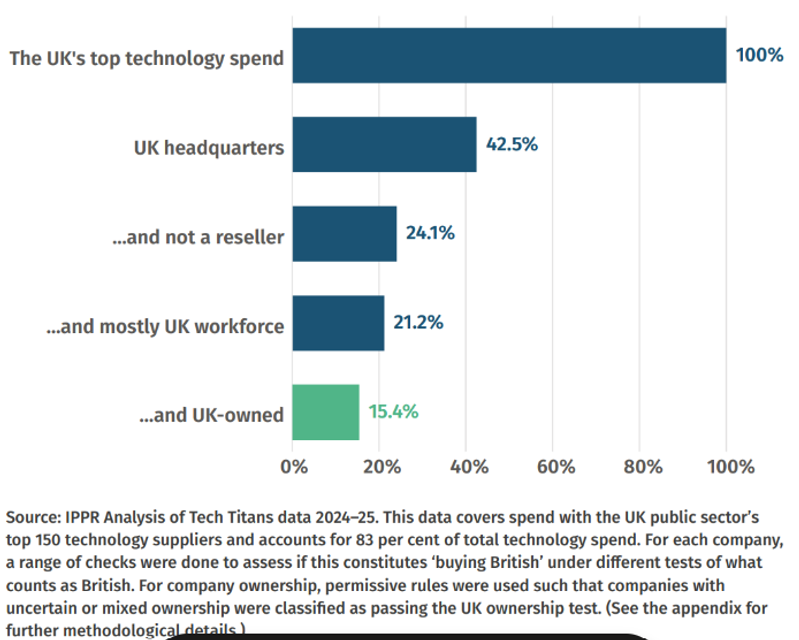
Researchers highlight the gap between Andy Burnham’s intentions to ‘buy British’ and the realities of the technology market. Previous analysis of the £19.2 billion worth of spending with the 150 largest suppliers to the UK public sector found that 42 per cent share went to companies with headquarters in the UK.
However, a closer look by IPPR reveals that only 15 per cent went to firms that are fully British, meaning they have UK headquarters and ownership, a largely local workforce, and are not resellers of products often made in the US (which accounted for 43 per cent of the spending going to UK-headquartered firms).
Researchers also found that almost twice as much UK spending ends up going to the US, compared with all other foreign countries combined.
The UK is prioritising ‘digital sovereignty’ (see note) in response to recent geopolitical developments, such as the US government’s recent restrictions on access to Anthropic’s latest models outside the US.
The government launched a £500 million Sovereign AI Fund in April 2026, and plans a further £140 million funding to scale domestic capabilities through the Sovereign AI Unit, announced in the budget last month.
IPPR researchers say that while building domestic capabilities is valuable, “it cannot be our only bet”.
The UK currently has limited leverage over countries that control the most advanced AI technologies, researchers warn. IPPR analysis shows that our own technological strengths, like chip design and the development of AI applications, offer little bargaining power, but other middle powers have better leverage.
In response to the UK’s exposure, IPPR researchers urge the government to:
- Buy technology as one customer, writing the right to switch suppliers into contracts
- Use procurement, investment and competition policy to shape markets and stop a handful of firms controlling critical technologies
- Build an alliance of middle powers with enough collective leverage to negotiate access to and oversight of AI technologies in case of a geopolitical standoff.
Roa Powell, senior research fellow at IPPR, said:
“It’s clear that government must do more to make sure the UK can shape its technological future by design, given the pace of change, and the US’s recent restrictions on access to the most advanced AI.
"But we cannot do it alone, and building domestic capability can’t be our only bet. The UK should be working with other middle powers, pooling our buying power to shape markets and using shared leverage to secure access to frontier AI.”
Darren Jones MP, former chancellor of the Duchy of Lancaster, who wrote a foreword for the report, said:
“Public anxiety about AI is rising fast, and the government needs to show it is in control of how this technology shapes people’s lives. But the challenge for policymakers is what level of control is realistic for a country of our size.
"The answer is that we can change how the state buys technology, back industries where the UK has a genuine opportunity to lead the world, and shape markets – but we can’t go it alone. We need to join with natural allies like France, Germany, Japan and Korea and make ourselves indispensable together.”
ENDS
Roa Powell, Nayana Prakash and Carsten Jung, authors of the report, are available for interview
CONTACT
Tom Jeffery, media consultant: 07772 941254 [email protected]
David Wastell, director of news and communications: 07921 403651 [email protected]
NOTES TO EDITORS
- The IPPR paper, Locked in: A realist’s agenda for digital sovereignty by Roa Powell, Nayana Prakash and Carsten Jung, will be published on Wednesday 11 November 2026 at 00:01. It will be available for download at: https://www.ippr.org/articles/locked-in
- About the authors: Roa Powell is IPPR senior research fellow; Dr Nayana Prakash is a research consultant with IPPR and a research affiliate with the Minderoo Centre for Technology and Democracy; and Carsten Jung is IPPR interim associate director for economic policy and AI.
- IPPR researchers define digital sovereignty as the “ability for a country to control and shape the technology it relies on”.
- Methodology: IPPR analysed UK government procurement data provided by Tussell. Figures on supplier nationality use Tussell’s Tech Titans dataset of 2024-25 which covers spend with the top 150 largest technology suppliers, which together account for 83 per cent of public sector technology spend.
- Chart: Less than £1 in 6 that the public sector spends with its biggest technology suppliers goes to firms that are British on every count