
A tough hand: Why rising youth inactivity demands urgent action
Article
On Thursday, new data will likely show the number of young people who will be out of education, employment or training (NEET) will surpass 1 million for the first time since 2013.
These figures have grown steadily since 2021 and mean around one in eight young people are neither engaging with the labour market nor taking steps to enter it. This recent surge has been driven more by rising inactivity than unemployment.
Defining inactivity and unemployment
Inactivity: Meaning people that are out of work but not actively looking for work.
Unemployment: Someone that is out of work but actively seeking it.
Figure 1: The number of 16-24 year olds not in employment, education or training has grown steadily since 2019
Number of 16-24 year olds not in employment, education or training, 2019–2025 (thousands)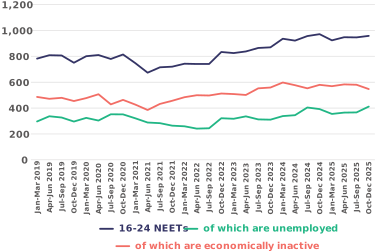
Source: ONS
Put another way, this is not simply a story about young people struggling to find work. More are outside the labour market altogether — not working, and not currently looking. Among these inactive NEETs, four in 10 are long-term sick. Poor health runs through the wider picture too: compared with young people overall, those who are NEET are more than twice as likely to have a mental health condition and 60 per cent more likely to have a physical health condition.
The UK is a poor performer by rich-country standards. Among 22 wealthy European OECD countries, the UK reportedly has the third-highest rate of 18–24-year-olds not in work or study, behind only Italy and Lithuania.
Much will be said about this cohort in the coming months, as the numbers continue to rise and politicians scratch their heads as to the right policy response. The Milburn Review into young people and work gives government a chance to answer that question seriously. But one point ought to unite us all, regardless of politics: the rise in NEET numbers is nothing short of a human tragedy – representing a huge loss of talent and potential. The focus is often on the fiscal cost – benefit spending, lost tax revenue and so on, but it’s the moral case for action which should carry equal if not greater weight.
This year IPPRset out to listen to young people and find out who NEETs really are. The grave and lasting toll being NEET takes on young people is stark.
The ‘human costs’ of being NEET
For many, the most immediate effect is a loss of self-worth. Work and education are not just sources of income; they are also sources of status, purpose and recognition. Young people we spoke to described the fear of being left behind, or of being judged only by qualifications they may not have.
I’m just so fearful that I’ll end up just wasting my life away and just not accomplishing something myself.
We are so much more than our qualifications. We are skills, we are life experiences… we’ve cared for people, we’ve looked after maybe ill relatives… we’re kind of being defined by these grades or by our qualifications when we’re so much more than that
The second loss is routine. Education and work provide rhythm to the week and shape to the day. Without that structure, time can become difficult to manage and motivation can become harder to sustain.
Sometimes when you don’t have structure in your days, it can get a bit daunting and it can feel like, oh, you’re just wasting your days away
The effect can be profound. Routine is foundational to wellbeing, and losing it can reinforce isolation, anxiety and low confidence –the very barriers that make it harder to move into work, training or education.
The third impact is the loss of “social capital”. Young people’s networks often change rapidly after school or college. Some friends go to university, others move away, and those who do not follow that route can feel left behind and unsupported to work out what comes next:
A lot of the friends I had…the group kind of got dissolved essentially because they went their separate ways through university
Beyond the age of 19, nothing's really in your control about what you're doing, what you might want to do ... because you don't really have that guidance beyond that point
Finally, being NEET delays independence. Young people are told that adulthood should be a period of growing autonomy: earning money, moving out, making choices and building a life. But for many, that transition is being pushed further away. High rents, insecure work and the cost of living mean that even those who want to move forward cannot always afford to do so.
With cost of living, it's difficult to make most decisions you want in life.
Many young people now stay with their parents longer to save money or because they cannot afford to move out immediately
This is why rising NEET numbers are not just a labour market problem. They represent a loss of confidence, connection, routine and momentum at precisely the stage of life when young people should be building all four.
It is hard to escape the conclusion that today’s young people have been dealt a tough hand:growing up through the impacts of austerity, alongside pandemic-related disruption to their education and facing a challenging labour market ahead.
Austerity
Today’s 18–24 cohort, born roughly between 2001 and 2008, grew up in a period in which much of the social infrastructure around young people was stripped back. Starved of funding, councils were forced to retreat to the bare minimum of services they were legally required to provide, while the promised ‘Big Society’ never filled the gap.
Just as this cohort was entering the years when informal, preventative support can matter most, youth services were cut sharply: the YMCA estimates that funding fell by 73 per cent in real terms between 2010/11 and 2023/24. In practice, this meant that compared with previous cohorts, many young people had:
- less access to informal, preventative support, just as other pressures around mental health, online harms and social media were intensifying
- fewer places to build confidence, social capital and belonging
- fewer safe spaces outside school and home
- a weaker early-warning system for identifying mental health problems, family difficulties and young people at risk of disengaging.
All of this is likely to have had knock-on impacts for this cohort today: on their confidence, their sense of belonging, their access to trusted adults and informal advice, and their ability to navigate choices about education, training and work.
Pandemic-related disruption
Today’s 18–24-year-olds were aged roughly 12 to 18 when schools and colleges first closed in 2020. That means they did not experience one uniform 'Covid-19 disruption', but a series of age-specific shocks.
For the younger end of this cohort, now aged roughly 17 to 21, the pandemic disrupted the foundations of secondary education: routines, peer groups, identity formation, teaching time, GCSE preparation and subject choices. This was not only a loss-of-learning shock, but a disruption to belonging, stability and confidence at precisely the stage when young people are meant to be forming educational pathways and a sense of direction. Absence from school skyrocketed during the pandemic and has remained high – with nearly one in five children (18 per cent) still missing 10 per cent or more of school up from 11 per cent pre-pandemic.
For the older end of the cohort, now aged roughly 21 to 24, the Covid-19 pandemic struck during high-stakes assessment, post-16 transitions and the launch of adulthood. Cancelled exams, uneven assessment arrangements and uncertainty over progression into further or higher education, apprenticeships or work created a wider 'sorting shock': affecting credentials, confidence and routes into adult life. For those entering university or the labour market, restrictions also limited early work experience, internships, workplace exposure, independent living and the social networks that normally help young people build momentum.
Across both groups, the pandemic was not just a disruption to schooling, but to young people’s whole lives. It limited the friendships, routines, informal support and first experiences of independence that normally help teenagers and young adults build confidence. For some, that loss of connection and stability is likely to have left lasting marks on mental health, motivation and readiness for work or further study.
A tough labour market for young people
Young people are usually hit hardest when the labour market weakens. But the gap is now especially stark: youth unemployment is nearly three times the overall rate, wider than when NEETs were last high on the political agenda in the early 2010s.
Figure 2: Youth unemployment is nearly three times the overall rate
Ratio between 18-24 rate of unemployment and the general rate of unemployment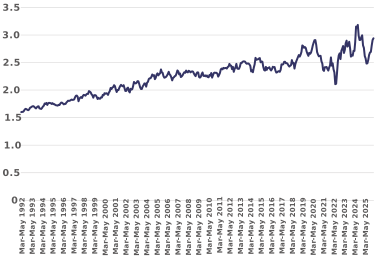
Source: IPPR analysis of ONS
We also find recent falls in vacancies have hit the sectors young people often rely on for their first jobs — retail, hospitality and accommodation — as households have been forced to cut back during the cost-of-living crisis.
But this is not only a cyclical problem. The sectors young people rely on for entry-level work are also being reshaped by technology. AI could reduce junior roles in particular, because many early-career tasks are more routine and less dependent on the judgement that comes with experience.
Hiring itself has also become more automated. Young people are often rejected en masse, with little human contact and few chances for feedback. Long forms, online tests and pre-recorded video interviews can be especially hard for those with low confidence, poor mental health or neurodivergence. As one participant put it, the process can feel arbitrary and exhausting:
It's almost obscene… no matter what you do or how many jobs you go for, it is pure chance that you will get through.
Conclusion
Taking action is now urgent. Young people are not doomed, but nor should they be expected to overcome, through resilience alone, challenges they did not create. The task for policy is to repair the routes into adulthood that have become too fragile for too many – replacing systems that deepen disengagement with support that helps young people find their place in society.
The Milburn Review is an important opportunity to meet the scale of this challenge. It should not settle for small tweaks to employment support, but set out a serious plan to rebuild the support around young people, prevent long periods of drift outside education or work, and create credible pathways into good jobs, training and independence. That will require a willingness to confront where existing systems are failing young people - and to remake them so they genuinely support participation, and enable young people to realise their talent and potential.
This blog was published in partnership with the Youth Future Foundation and Reed in Partnership.
Related items

A better deal: Tackling the NEET crisis
Around a million young people in the UK are now not in education, employment or training (NEET), the highest number for more than a decade.
Raising the bar: Strengthening living standards while banning exploitative zero-hours contracts
Labour’s manifesto committed to banning exploitative zero-hours contracts as part of sweeping upgrades to workers’ rights.
Work isn't working: Family, work and progression on a low income
Most children in poverty in the UK are in working households, a phenomenon that has emerged since the early 2000s.