Article
The Home Office's net migration target has created a perverse incentive for the government to reduce the number of international students - officially counted as 'migrants' if they stay for over a year - in order to achieve an overall reduction in migrant numbers. By contrast, the Department for Business, Innovation and Skills (BIS) is promoting growth in the international education sector, whose exports are estimated to be worth £17.5 billion to the UK economy - BIS anticipates that numbers of international students in higher education will grow by 15-20 per cent over the next five years. The Coalition's policies are not only confusing and incompatible, but are harming the UK's economy.
The UK needs a student visa regime that clamps down on abuse - but also one that is open and flexible enough to attract foreign students in a competitive global market. Above all, the government needs to unequivocally commit to increasing the number of international students studying at British education institutions.
This report outlines the Coalition government's approach to policy on international students, provides an overview of the recent data and trends, and draws together research that illustrates the impact of international students and policy on the national economy, local areas, and institutions in different parts of the education sector. It charts the sector's future prospects based on current trends, explores examples of successful policy in other countries, and also includes detailed case studies - including original polling of the perceptions of Indian nationals who are considering studying overseas.
Its key recommendations include:
- the abandonment of the net migration target, which is a bad measure of policy
- investment in gathering improved longitudinal data about students' pathways through the immigration system
- more selective and targeted screening of prospective international students, and greater support for education institutions that are licensed to sponsor them
- introducing a modest levy on international students for NHS coverage, equivalent to the typical cost of private medical insurance for a student (around £100-£200 per year), but offsetting this charge with corresponding advantages, including increased working rights during and after study
- an intelligence--led independent review of the burgeoning student visitor visa route to monitor any unusual patterns.
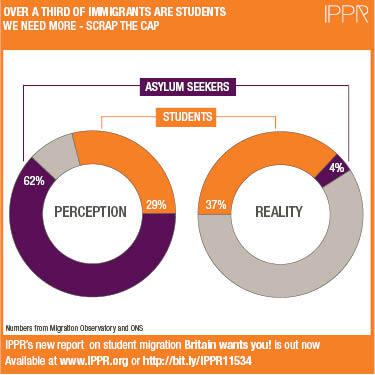
Analysis of polling data shows that when it comes to guessing who makes up the immigrant population, public perception differs widely from reality.
Click to retweet, or visit Google+ to share the animated version.
Related items

Bricks vs clicks: The case for an online sales tax
It's time to rethink how we tax retail.
Beyond boom and bust: The supply case for social housing
How the government can use social housing to unlock housing supply and demand.
Aligning for growth? The benefits of an EU-UK mutual recognition agreement
Scoping the potential next frontier of a deepening relationship between the UK and the EU.