
Britain’s broken social contract: Young people have lost faith in their future
Article
Drawing on new evidence, this blog examines the decline in young people’s optimism about work, success and social mobility, and argues for a new deal to rebuild trust in Britain’s social contract.
For much of the post-war period, Britain offered young people a basic promise: if you work hard and do the right things, you can expect greater security and opportunity than the generation before you. That promise was never shared equally. But for many young people today, it feels not just frayed, but fundamentally fractured.
Young people today are less confident in their future. They no longer believe that basic promise – hard work will pay off – to be true. This matters not only for their own lives and the prospects of their generation, but also because the social contract depends on citizens believing that effort and contribution will be met with progress from one generation to the next.
Figure 1: Only one in four 16- to 29-year-olds in Great Britain agree that everyone has a fair chance to go as far as their talent and hard work will take them
The proportion of people by age who agree that everyone has a fair chance to go as far as their talent and hard work will take them, April 2026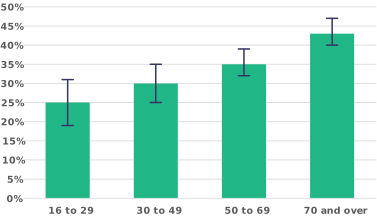
Young people do not believe that hard work will pay off, with only one in four believing everyone has a fair chance to get on in life. Whilst all age groups agree to some extent that the game is rigged, the belief that hard work and talent are enough to get ahead declines with each new generation, with young adults the least convinced.
Over 70s are nearly 20 percentage points more likely to believe that everyone has a fair chance to go as far as their talent and hard work will take them. For most young people, the link between effort and opportunity no longer feels secure.
This pessimism isn’t just a symptom of a generation in distress. It is also a warning light. If the next generation believes that the game is rigged, the risk is that they participate less in the economy, society, democracy, and in their communities. The risk is not just for them as individuals, but for all of us who rely on the next generation to innovate, pay their taxes, create art and culture and revitalise communities.
Young people are losing faith in the future
We can see how the fractured relationship between effort and reward is playing out in how confident young people feel about their futures. The proportion of young people who are pessimistic about their future has increased every year since 2015-17.
Figure 2: A greater proportion of young people think they have a low chance of success and a high chance of long-term unemployment
Proportion of 16- to 21-year-olds rating their likelihood of success as 20 per cent or below (left), and rating their chances of long-term unemployment as 80 per cent or above (right)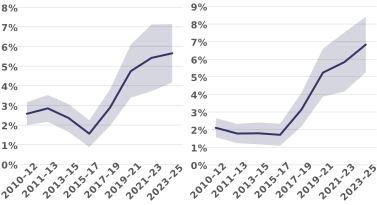
Source: IPPR Analysis of Understanding Society 2010 to 2025. Note: 95 per cent confidence intervals shown shaded area.
Since 2015, the share of young people who believe they have a low chance of becoming successful has tripled. It was less than 2 per cent - almost unheard of – in 2015-17. By 2023-25, it had risen to 6 per cent. That’s roughly two students in every classroom who think they have a low chance of success.
Young peoples’ expectation of work tells a similar sad story. Seven per cent of young people now think they have a high chance of becoming long-term unemployed – up threefold since 2015-17.
These worries are not unfounded: the number of young people who are out of work and education is rising, with over 1 million 16-24 year olds now out of education, employment or training. Milburn’s interim report into the rise of young people neither earning nor learning found no single cause of the crisis, but many challenges across education, health, social security, and the labour market.
Figure 3: A falling proportion of young people think they have a high chance of success and a low chance of long-term unemployment
Proportion of 16- to 21-year-olds rating their likelihood of success as 80 per cent or above (left), and rating their chances of long-term unemployment as 20 per cent or below (right)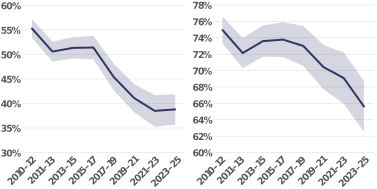
Source: IPPR Analysis of Understanding Society 2010 to 2025. Note: 95 per cent confidence intervals shown shaded area.
At the other end of the scale, fewer young people are optimistic that success is within reach. The share who felt highly likely to succeed has fallen from 55 per cent in 2010–12 to under 40 per cent today, leaving only two in five confident in their future. The same is true for becoming long-term unemployed in 2010-12 – 75 per cent of young people felt they had a low chance of becoming long-term unemployed – by 2023-25 that had fallen to 66 per cent.
From the data, the turning point appears to have arrived around 2015-17, when optimism among young people began to decline and pessimism started to rise. Understanding what changed in this period is crucial if we want to restore confidence to the next generation. During the mid-2010s, several pressures were intensifying at once: the effects of austerity were becoming more visible, the online information environment was being reshaped by personalised algorithms, and young people’s mental health was beginning to deteriorate.
A generational shift
Expectations appear to be falling across the board, for all young people regardless of their background. The social contract has fractured not just for a proportion of young people, but for a whole generation. But the young people who have the bleakest outlook are those with poor mental health. Our analysis estimates that 4 in 10 women and 3 in 10 men aged 16 to 24 have poor mental health1.
Half as many young people experiencing poor mental health believe they have a strong chance of becoming successful, compared to their peers (24 per cent v 48 per cent). This means that whilst 1 in 2 (48 per cent) of young people with no mental health problems are still confident they will live a successful life, only 1 in 4 (24 per cent) with poor mental health share the same positive outlook. Whilst the spectrum of mental health conditions and individual outcomes is vast and nuanced, there seems to be a relationship between how young people are feeling right now and how they feel about their futures.
This relationship between mental health and expectations is complex, and it almost certainly runs both ways. Poor mental health can darken how young people see what lies ahead; equally, growing up with little confidence that effort will be rewarded can weigh heavily on wellbeing. But whatever the direction of causality, the gap is stark. Young people experiencing poor mental health are markedly more pessimistic about their chances of success and more likely to think long-term unemployment could happen to them.
Why this matters for Britain
If young people are losing faith in their future, the consequences will not be confined to the labour market. A society in which the transition to adulthood feels blocked will also see changes in family formation, housing decisions, trust in institutions, civic participation, and willingness to invest in the future. We are starting to see patterns of ‘financial nihilism’ in the UK – where young people who feel the system no longer rewards effort, spend more relative to their wealth, invest in riskier assets like cryptocurrencies, and work less.
The problem is not simply that young people feel anxious, or pessimistic. It may be that many are drawing reasonable conclusions from the conditions around them: high housing costs, insecure work, strained public services, and a weaker link between effort and reward than previous generations were told to expect. This is why we must explicitly acknowledge Britain’s broken social contract. It helps explain why declining optimism should be taken seriously not as a cultural complaint, but as a structural signal.
When the institutions that shape early adulthood stop delivering security, belonging and progress, distrust deepens and the legitimacy of the system itself starts to erode. Britain cannot afford a future in which an entire generation concludes that the country has little to offer them in return for their effort. Where the basic promise that each generation will make progress has faltered.
Rebuilding the deal
Rebuilding that deal means doing more than helping young people manage decline. It means renewing the foundations of the social contract itself: making housing more affordable and secure, improving access to good work, taking mental health seriously, and restoring a credible sense that effort can still lead somewhere. This will require the action of government, employers, and civil society working together towards a shared goal.
The task of re-building is not nostalgic. There is an opportunity to create a new settlement that matches the realities of modern Britain, while renewing the promise that the next generation should be able to build a decent life.
That is the ambition behind State of a Generation: a major programme of work combining research, expertise, and the voice of young people to understand what life is really like for young people in England today, and to work with them to shape a new deal for their future.
The IPPR State of a Generation review is a programme of work designed to see the world through the eyes of young people and develop a holistic policy programme that responds to the challenges they face. The review is supported by McDonald's, Youth Futures Foundation and Big Change.