
Cost of living, economic growth and stability: How to make this autumn budget a success
Article
In the autumn budget the chancellor can take three steps towards improving people's living standards.
Andy Burnham has had a strong start as prime minister. He comes out of the Labour party conference in Liverpool having achieved everything he hoped for during his first three months in office: Labour’s poll ratings are up, he is liked amongst voters, and he has set out a clear and coherent set of priorities for governing.
The vibes, as they say, are good.
Yet, more circumspect politics watchers point out that Burnham is yet to face a real political challenge. They argue that the true test of the Burnham premiership is his position after he has navigated the challenges on the horizon: welfare reform, a winter NHS crisis, the next energy price spike, and migration reform. They are right. And the first of these tricky challenges, the budget, is running at them fast.
the aim in Labour circles is to deliver a “do no harm” budget
After two budgets under Rachel Reeves that were both large in scale and in controversy, the aim in Labour circles is to deliver a “do no harm” budget. Chancellors usually want to make a splash with their moment in the spotlight. But, this time around, John Healey will be happy if this budget is seen as sound, stable and, frankly, forgettable.
However, two factors make achieving this difficult.
First, the chancellor is facing significant fiscal headwinds, largely because of President Trump’s war in Iran which is driving up borrowing costs and inflation (alongside the cost of already committed spending and a downgrade associated with lower migration). Before the chancellor has even made any additional spending pledges (or tax cuts), we estimate that his headroom (almost £24 billion in March) has fallen to £9–17 billion (see figure 1). Moreover, some further fiscal pressures will be added to this at the spending review next year.
Figure 1: We estimate that current budget headroom has fallen from almost £24 billion in March to £9–17 billion, depending on the OBR’s modelling choices
Estimated current-budget headroom in 2029/30, £bn, relative to the OBR’s March 2026 forecast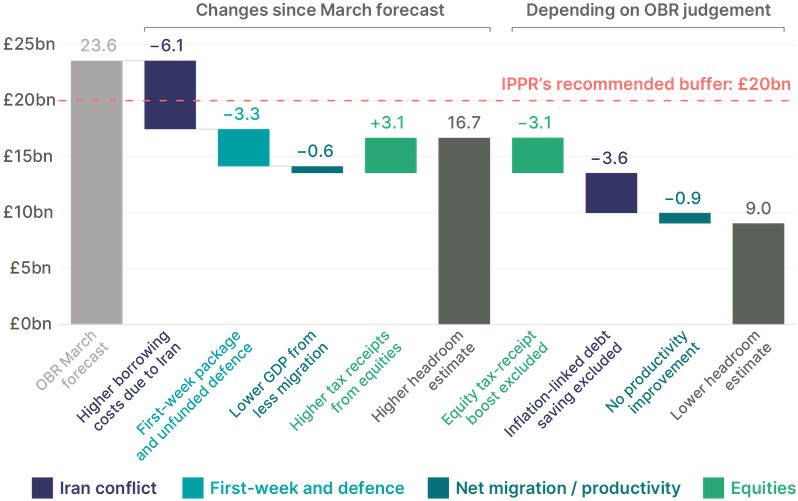
Source: IPPR calculations based on OBR ready reckoners and market data
Note: The Iran conflict raises borrowing costs through higher bank rate and gilt costs. The higher estimate includes an uncertain later saving from RPI inflation falling below forecast (that we remove in the lower case). We do not assume that the OBR model a permanent hit to growth (scarring) from the conflict. First-week and defence commitments comprise around £2.1 billion for Burnham’s first-week measures, £0.9 billion of unfunded defence commitments, plus financing costs. Lower net migration reduces GDP and receipts, using OBR sensitivities. The higher estimate assumes higher productivity offsets half the GDP loss. Higher equity prices increase capital gains tax, inheritance tax and stamp duty receipts (see OBR ready reckoners). We assume that the additional positive effects of inflation (from fiscal drag) broadly cancel out the negative (benefits uprating).
And, second, a “do no harm” budget is directly in tension with the ambitions set out by Andy Burnham, including creating “breathing room” on the cost of living and delivering “growth in all postcodes” (as well as wider promises on eg youth unemployment). Achieving these goals requires additional spending and significant economic reform, both of which will entail some economic pain for some groups.
Can the chancellor navigate these conflicting goals? At IPPR, we think it is possible: but it is a fine needle to thread. Here’s how he can achieve it.
Step 1: Keep taking on the cost of living
As we argued in ‘A war on bills’, progressive governments abroad have shown that attention-grabbing policies on the cost of living can be a powerful way for the government to signal to citizens that they 'get' the scale of the cost-of-living challenge (even if it is not fully in any government’s control).
attention-grabbing policies on the cost of living can be a powerful way for the government to signal to citizens that they get the scale of the cost-of-living challenge
This government has already taken first steps on this, but we argue that continued action is needed to keep proof points in the public’s attention.
The chancellor should:
- Introduce a rent stabilisation mechanism, putting in place a "double lock" on private rents. Annual rises would be capped at whichever is lower, inflation or wage growth, both within tenancies and between them. This ensures both predictable income growth for landlords and risk sharing between landlords and tenants during inflation shocks. And it can be designed in a way that does not discourage housebuilding, including via exemptions for new builds and rennovations. This would also be accompanied by a number of measures that would support house building and market functioning (see the full IPPR report here).
- Put in place a temporary energy price ceiling, bringing benefits through lower inflation and signalling to households that the government is on their side. We argue for capping household energy bills at £2,000 in Q1 and Q2 2027, which only binds in Q1 based on current market prices (see figure 2). This should be accompanied by freezing fuel duty for another half year. The temporary intervention costs less than £0.5 billion in total, and lowers headroom by less than £0.1 billion by 2029–30. Crucially, this provides insurance against permanent economic damage, and reduces pressure for the Bank of England to raise rates (particularly if inflation expectations increase further). Avoiding them could be net beneficial in fiscal terms – as we model in detail in ‘Price caps and economic stability’. The government should set an upper spending envelope for this policy.
Figure 2: A temporary price ceiling at £2,000 would lower inflation peak and reduce second round inflation effects, with macroeconomic benefits
Energy price outturn and projections with and without a £2,000 price ceiling vs OBR baseline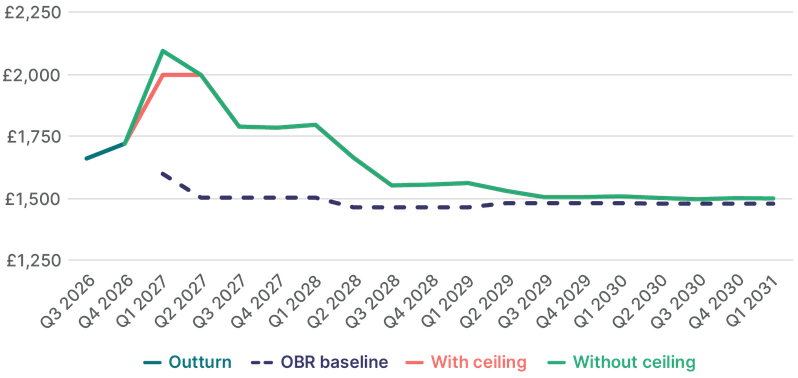
Source: IPPR calculations and modelling based on OBR forecasts (March 2026), published Ofgem price caps, and ICE energy futures
- Uprate the local housing allowance (LHA), which has been frozen since 2024. Around 1 million households on Universal Credit alone face a shortfall between their housing costs and LHA. The average shortfall for UC households was £200 a month, equivalent to 30 per cent of the UC standard allowance for a couple, and greater still for a single person. Blanket freezes have become untenable, and unfreezing LHA is a highly targeted way to help low-income households that are struggling with the cost of living. This should not be a replacement for incentivising more (social) house building. This could cost £2.5 billion in 2029–30, but the above rent stabilisation measure could reduce it by about £1 billion.
Step 2: Deliver economic growth through reform and industrial policy
The only way to sustainably tackle long term cost of living pressures is to drive up economic growth and productivity. The UK has already taken steps to achieve this including increasing public investment, undertaking planning reform, and setting out an industrial strategy to support frontier sectors.
But the chancellor should do more to boost growth.
- Narrow down the focus of industrial strategy on key frontier clusters, including advanced manufacturing and AI, and focus industrial policies at them. This should include launching a campaign to secure joint venture (JV) investments in frontier sectors, and explicitly updating the National Wealth Fund (NWF) strategic steer to enable more proactive discovery of these investment projects in collaboration with strategic authorities.
- Give selected public financial corporations more borrowing powers, including to help them build out the infrastructure needed for growing frontier clusters. This could mean allowing them to borrow and invest as part of an updated fiscal rules metric, but only for narrowly specified projects, with clear future financial flows to borrow against. However, an overall envelope of perhaps £10 billion should be strictly set.
- Introduce a ‘new youth contract’ to solve the NEETs crisis. This would fund entry-level jobs through a ‘work start’ programme where these are scarce, and reform apprenticeships to prioritise young people and to focus on growth sectors. It would also create a universal youth employment service with a single-rate youth allowance in place of the current universal credit rates based on work capability. This would cost about £2 billion by 2029–30. See our recent IPPR report on the NEETs crisis for details.
- Introduce a new foreign investor visa – the ‘British business investment visa’ (BBIV), creating a targeted route to live and invest in the UK (see full IPPR proposal here). Applicants would be expected to invest through a pooled investment vehicle overseen by the British Business Bank (BBB), the UK’s state-owned economic development bank. This, by definition, would mean investment goes into areas that are currently held back by lack of capital.
- As part of fiscal devolution, give local leaders greater autonomy over billions more to invest in transport, housing and regeneration. England’s mayors should be handed a 5 per cent share of income tax revenues, shifting an extra £3.8 billion a year out of Whitehall and roughly doubling the funding under their control. This should be combined with measures to make sure this is fairly distributed (via a tariff and top-up system) and new regional audit offices to hold MCAs accountable for spending (see full IPPR paper here).
this should be a budget in which the government shows it can deal with fiscal pressures by raising revenues in a fair and pro growth way
Step 3: Maintain a plan for fiscal responsibility
All advanced countries are experiencing a spike in bond yields because of global headwinds. However, the UK’s bond yields are higher than comparable countries. This is the result of historically higher inflation in the UK, market uncertainty about fiscal plans and a fall in UK institutional buyers. Notably, there is another approximately £11 billion in fiscal pressures that the government will need to face at next year’s spending review (including SEND spending and already pencilled-in spending cuts). This could significantly reduce headroom and require fiscal tightening. Financial markets know this and are therefore charging a UK premium of 0.2 to 0.4 percentage points on UK gilts (costing up to £3.4 billion by 2029–30), according to our estimates.
To send a signal on fiscal responsibility, the chancellor should undertake the following.
- Maintain a commitment to Labour’s fiscal rules and act to restore fiscal headroom to manage future instability and pressures. To do so, in combination with the spending commitments set out in this blog, we recommend the chancellor raise £16 billion at this budget in a pro growth way.
- First, reform Bank of England losses (£5 billion) and introduce a temporary increase in the commercial bank surcharge (£1 billion). Because of the way the UK accounts for quantitative easing, taxpayers lose £18 billion at the Bank of England every year – almost as much as the Home Office’s annual budget. This is not normal: other countries deal with this differently. We recommend deferring Bank of England losses, in line with the European Central Bank and the Bank of Canada. This would save the government significant amounts of money in this parliament (at least £5 billion in 2029–30) while not impacting banks' bottom lines. To address the large windfalls banks are making from higher interest rates, partly by not passing them on to consumers, the government should temporarily increase the bank surcharge, which could raise £1 billion or more.
- Second, reform capital gains tax (CGT) together with a ‘super exemption’ for high growth start ups, and generous loss relief (raising approximately £10 billion). Our current CGT regime is flawed and full of loopholes. At least half of current capital gains are related to labour income but taxed 23 percentage points less for top earners. This is why, for over a decade, experts from across the political spectrum, as well as the IFS’s authoritative Mirrlees Review, have recommended equalising capital gains and income tax, while reforming the base so as to spur investment. Both should be done now. To boost the economy's "animal spirits", especially in the UK’s frontier business clusters, there should also be a new exemption: zero capital gains tax for all scale-ups that have increased in value by at least £50–100 million.
- Third, introduce a modest online sales tax (OST), offset by an equivalent reduction in high street business rates (net revenue impact 0), to level the playing field between online and bricks-and-mortar retailers. The tax would apply at a rate of 2 per cent on remote sales, with a reduced rate of 1 per cent for click-and-collect purchases, recognising they generate footfall for physical stores. Depending on the final design, this could generate around £1.5 billion. Tax revenue should be used to fund permanent business rate reductions for businesses that drive footfall on high streets.
In sum, this should be a budget in which the government shows it can deal with fiscal pressures by raising revenues in a fair and pro-growth way.
Giving people breathing room on the cost of living will be essential but putting in place a growth strategy, focussed on building the UK’s frontier clusters, will also be essential for raising living standards enduringly.
* More on this forthcoming from JRF.
Related items

Devolution that delivers: Fiscal power for regional growth
The UK is one of the most centralised countries in the developed world, and one of the most regionally unequal.
A better deal: Tackling the NEET crisis
Around a million young people in the UK are now not in education, employment or training (NEET), the highest number for more than a decade.
Harry Quilter-Pinner discusses rising borrowing costs on BBC News