Get some perspective: Scottish income tax is lower than you think
Article
As the Scottish budget comes into view, we can expect income tax to play a central role. It is the biggest lever the Scottish government has on the revenue side of the budget.
It is also a lever which politicians find difficult to use to balance the budget. For example, the SNP manifesto earlier this year committed not to increase the number of bands or their thresholds.
The debate about income tax in Scotland is dominated by comparisons with the rest of the UK. The Scottish system includes a tax cut relative to the UK – the starter rate at 19 per cent on income between £12,571 and £16,537 saves Scottish taxpayers around £40 per year. This token sum is the basis on which the Scottish government claims, correctly if somewhat disingenuously, that more than half of Scottish taxpayers pay less income tax than they would in the rest of the UK.
Comparisons with the rest of the UK also dominate debate about the income taxes paid by the other half of the tax paying population. The precise income level at which someone tips from paying less to paying more (about £33,500) features in opposition lines, with accuracy and disingenuity matching the government’s – if £40 is a paltry income tax saving then it is also a paltry additional burden (for which your income has to reach about £37,500).
At incomes above £43,662 the picture changes. The Scottish higher rate of 42 per cent kicks in while taxpayers in the rest of the UK continue with a marginal rate of 20 per cent until their income passes £50,270. At that threshold a Scottish income taxpayer contributes over £1,500 more than they would with the system in the rest of the UK. From there the gap grows as Scottish rates are a few points higher than in the rest of the UK.
Figure 1 puts these numbers in perspective. It shows the income tax and social security paid in the rest of the UK and in other European countries relative to Scotland across the income spectrum (this is based on OECD calculations which use different ranges for different countries).
Figure 1. Scotland has low personal taxes by European standards across the income spectrum
National and local income taxes plus employee social security contributions in 2025-26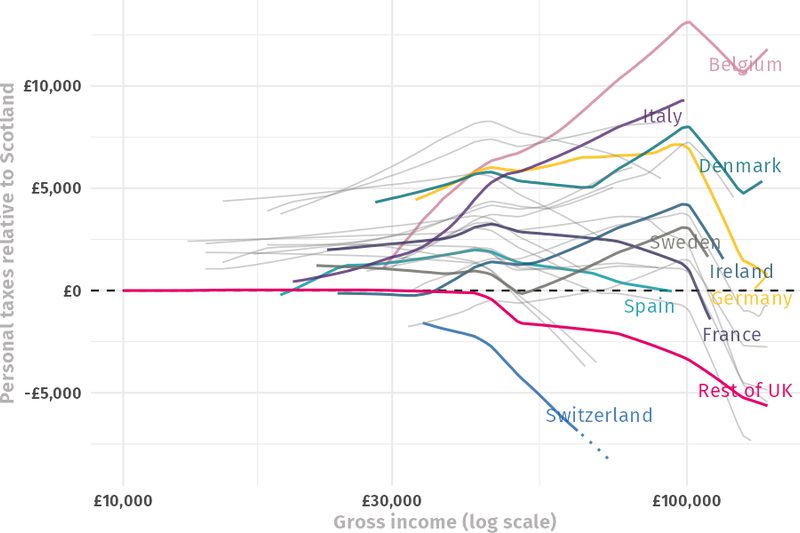
Source: Data on European taxes are from the OECD’s calculations, and have been converted to GBP using household consumption PPP exchange rates, also from the OECD. Taxes are shown for single people without children for comparability with the UK’s individual-based system. Gross earnings are shown on a log scale to match the distributional pattern of incomes across the population.
See methodological note below.
While at the upper end of the spectrum Scottish taxpayers clearly pay more than those elsewhere in the UK, the saving from the 19p starter rate is barely visible.
But far more striking is the fact that European taxpayers pay significantly more than they would in Scotland (with the exception of Switzerland which drifts away from the scale of figure 1). This is not just a high-income phenomenon but is clear across the spectrum. Those in Scotland who pay £40 less than they would in the rest of the UK are paying much less, often thousands of pounds less, than they would in other European countries.
At first glance this might be thought of as something to celebrate – less tax means more money in Scottish citizens’ bank accounts. From an individual perspective paying less tax has that attraction, but from a collective perspective it makes it harder to deliver the public services people depend on. Those public services often exist because private provision is either ruled out (e.g. defence) or more expensive than collective provision (compare American health costs with European systems).
The false economy of lower taxes is becoming apparent across the UK. Potholes in the street translating into the cost of damaged wheel axles is the anecdotal illustration. But researchers at the University of Loughborough have quantified the increase in the cost of living that comes with underfunded public services.
Their research invites members of the public to deliberate the minimum income households need to reach a decent standard of living and participate in society.
- In 2024, members of the public added £200 per working-age adult to the annual total in order to pay for health services like physiotherapy or counselling while on NHS waiting lists.
- In 2026, the money households need for rent jumped as research participants concluded social housing is no longer a realistic minimum housing option, given its lack of availability.
This is UK-wide research. The situation in Scotland may be different in degree (we have more social housing, for example) but the direction of travel is common. Government revenues are not keeping pace with the costs of delivering services for a variety of reasons, including our ageing demographics and the impacts of climate change. The Scottish government is responding to the pressure by trying to reduce spending rather than increase revenue.
The Scottish government’s approach to reducing spending is not presented as cutting services. Instead, it is couched in terms of reform. Efficiencies are to be discovered, bureaucratic bloat to be cut, a preventative agenda adopted, services reconfigured and restructured, and so on and so forth . While these are laudable aims, as we have argued elsewhere, they are not new ideas. Public services, struggling with the ongoing impact of 2010s austerity, have been under constant pressure to work more efficiently. This is not to say there is no room for improvement, just that we shouldn’t hold our breath that cost savings will balance the budget. Certainly, the Scottish government has not presented credible analysis that reorganising health or local government will generate significant savings, or that the public sector workforce can be shrunk without damaging public services.
What would happen if broad-based taxes were part of the strategy for dealing with pressure on the Scottish budget? If, as well as asking those with the broadest shoulders to pay a bit more, we also asked everyone to contribute on the grounds that the alternative would be more costly? What would happen, for example, if we added 2p to the starter, basic and intermediate income tax rates (the rates that bring in just over half of Scottish income tax revenue)?
The total income tax revenue in 2027-28 would increase by around £1.2 billion. This would meaningfully relieve pressure in the budget, allowing for different choices whether more investment or sustaining public services. But would it do this by transferring the pressure to households’ budgets?
Figure 2 shows how much that £1.2 billion would change household incomes, with the impact being generally very small.
Figure 2. A two pence increase in the lower income tax rates would make very little difference to people’s disposable income
Average disposable income (after housing costs, equivalised) by income decile before and after a 2p increase in the starter, basic and intermediate tax rates. Scotland 2027-28.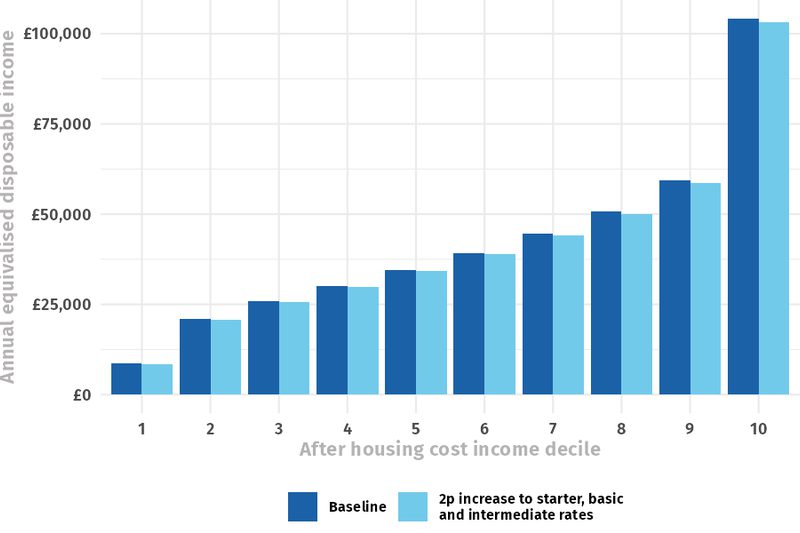
Source: IPPR Tax and Benefit Model. Disposable income is “equivalised” to account for the number and ages of people in a household, recognising that larger households need more income but can share some costs. A household’s equivalised income is the income of a two-adult household with an equivalent standard of living.
To put the impact of this illustrative tax increase in perspective, consider an alternative of underfunding public services. The Minimum Income Standard estimate that NHS waiting lists result in additional costs of £200 per adult gives a benchmark of about £400 per household. Adding 2p to lower income tax rates would cost households less than this on average in each of the bottom four income deciles.
This isn’t a specific policy proposal, but an order-of-magnitude comparison. If income tax rates are treated as untouchable despite budget pressures, it is far from clear that income taxpayers are thereby made better off. Equally this is not to argue that raising more revenue should only be done by increasing the starter, basic and intermediate rates, just that a serious approach to tackling Scotland’s fiscal gap should not rule them out.
Do higher taxes in other European countries act as a drag on their economies? Our research shows this is not the case. Many European countries sustain economies that are more productive, innovative and dynamic than Scotland’s (or, indeed, the UK’s), doing so with higher taxes and higher social spending.
The tax debate in Scotland has lost perspective. In the face of mounting pressures politicians speak a language of simplification and restraint. But ordinary citizens pay low tax compared with their European neighbours and it isn’t to their benefit.
Methodological note
Our figures exclude social security contributions and payroll taxes paid by employers and cash benefits received by taxpayers for all countries. An alternative way of thinking about costs is the OECD’s concept of the 'tax wedge'. This includes both, and allows comparison of the cost of employing someone and their disposable income. While that approach has some advantages for international comparison, we have presented the relationship between earnings and personal taxes as it is more readily understood in debates about Scottish tax levels. Running the same analysis using the OECD tax wedge produces very similar results. The notable exceptions are France and Denmark where employers social security contributions are high and low respectively.