Levelling the playing field: The BBC, Big Tech, and the case for a bold charter
Article
The upcoming charter renewal is the moment to give the BBC the resources, freedom and mission it needs to engage with technology firms on its own terms.
The BBC faces a seemingly impossible choice. As trust in public institutions erodes and disinformation spreads online, its role to act in the public interest, with impartial, high-quality and distinctive outputs has never been more important. But fulfilling this role has become harder as the BBC competes in a crowded landscape dominated by mammoth technology firms.
The BBC must meet audiences wherever they are, but increasingly that means meeting them in spaces owned and controlled by companies with values that aren’t its own.
This is not the BBC’s failure, it is a symptom of an out-of-date regulatory environment.
The BBC has tried to adapt, producing short-form social media content, experimenting with AI innovation, and pursuing partnerships with large technology firms like YouTube. But so far these efforts have been piecemeal, and the BBC has repeatedly found itself forced to choose between reaching audiences and compromising its principles.
This is not the BBC’s failure, it is a symptom of an out-of-date regulatory environment. While the BBC faces stringent public obligations and close scrutiny, competing technology firms operate under minimal constraints.
Regulation needs to be updated to ensure that platforms use the BBC’s content fairly, including new requirements for technology companies to be transparent on how they use BBC content and new standards to ensure BBC journalism appears prominently on social media sites.
The status quo cannot continue and the upcoming charter renewal is the moment to give the BBC the resources, freedom and mission it needs to engage with technology firms on its own terms.
Renewing the BBC in an age of platform gatekeepers
When the BBC’s current charter was written in 2017, TikTok had not yet reached the UK, fewer than half of UK households subscribed to a streaming service, and ChatGPT was still five years away. Yet in less than a decade, the media environment has transformed completely, leaving the BBC in an unrecognisable competitive landscape.
four-15-year-olds now spend more time watching YouTube than all public service broadcasters combined
Social media platforms have consolidated their gatekeeper power with 79 per cent of the UK population using social media for around 1 hour and 30 minutes a day and the BBC chased by Meta as the most common source of news in the UK. AI is also emerging as an information gatekeeper in its own right, as Google AI Overviews reach two billion users a month, and 24 per cent of people use AI to find information each week. This transformation has been especially marked for younger audiences, as four-15-year-olds now spend more time watching YouTube than all public service broadcasters combined.
The BBC can no longer expect to fulfill its public service mission without engaging directly with these platforms. Yet, how it should engage remains deeply contested. These trade-offs are now coming to a head as part of the BBC’s charter renewal.
The BBC and big tech: A history of uneasy engagement
The BBC’s incentives fundamentally differ from those of big technology firms. Technology platforms generate revenue through advertising, incentivising them to maximise time spent on their platform through highly personalised feeds. Meanwhile, the BBC operates under strict editorial standards that govern accuracy and impartiality and is the UK’s most trusted news source.
The BBC had 14 billion social video views across 150 channels in 2024, including on YouTube and TikTok, and their annual report sets out their plan to increase their presence on both platforms.
Yet despite conflicting values, the BBC acknowledges the importance of meeting audiences ‘wherever they are’. The BBC had 14 billion social video views across 150 channels in 2024, including on YouTube and TikTok, and their annual report sets out their plan to increase their presence on both platforms.
The strategy seems simple: the BBC posts on other platforms to increase their reach and value – and to bring people to BBC platforms. But, in practice, the BBC’s strategy differs depending on the context (table 1).
Table 1: Possible engagement strategies between the BBC and Big Tech
BBC strategy | Description | Examples |
Resist | BBC resists engagement with big technology platforms and maintains strict separation. | The BBC attempts to block AI companies from scraping its content for AI answers. |
Compete | BBC withholds some content from platforms to remain competitive. | BBC sounds competes with streaming services by withholding popular content. |
Distribute | BBC distributes content widely across platforms to increase reach and meet people wherever they are. | BBC news will post significant content across social channels so that audiences don’t need to visit BBC news directly. |
Concede | BBC creates content with third-party platforms as the primary destination. | BBC commits to producing YouTube-first content. |
The BBC is forced to play by technology companies’ rules
All of these strategies for BBC engagement with big tech may have a time and a place. But, the BBC rarely gets to choose on its own terms. In the current environment, whichever approach they take will come with significant compromise. We argue that this is largely due to the power imbalance between the BBC and big tech.
Technology platforms command vast resources, monopolise data on how audiences engage with content, and operate under few regulatory constraints. In contrast, the BBC works on a tight budget and within strict public accountability frameworks.
The result is a double bind. When the BBC tries to disengage from technology giants, the results are messy and ineffective, and when it engages, it risks compromising the very things that make its offer so unique.
We illustrate this through exploring two case studies, the BBC’s response to the rise of AI versus its response to the rise of short-form video streaming.
Case study one: Resisting the rise of AI
The BBC has responded to the rise of AI by primarily blocking AI companies from accessing its content. In theory, this makes sense given the high risk that AI companies will misrepresent BBC journalism or scrape it without permission.
But, in the absence of clear regulation, this strategy is largely self-defeating.
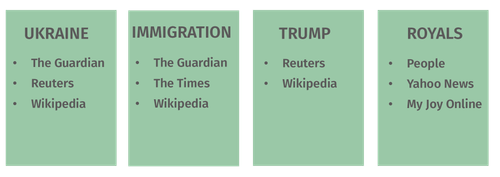
ChatGPT, blocked from accessing BBC content, will still answer questions about BBC reporting by drawing on secondary sources, increasing the risk of BBC content being misrepresented (figure 1).
Figure 1: Sources used by ChatGPT in response to questions about BBC reporting on popular news topics
Meanwhile, Perplexity and Google AI Overviews continue to cite BBC content regardless. The BBC has threatened Perplexity with legal action, but Google’s search dominance makes opting out almost impossible for publishers who still want to appear within normal Google Search.
The result is incoherence. BBC content appears in some AI tools but not others, shaped less by the BBC’s choices than by the absence of enforceable rules. Technology companies hold all the cards, and the BBC isn’t given a choice to opt out entirely.
Case study two: collaborating on YouTube’s terms
The BBC has long been aware that the rise of YouTube, especially among young audiences, makes it essential for them to post content on the platform. For a long time, the BBC has posted clips and trailers on YouTube, as well as a significant amount of full BBC content – with the aim of meeting young audiences where they are and driving them to BBC platforms.
The BBC’s new partnership with YouTube marks a departure from this. The BBC will now make content specifically designed for YouTube’s audience in return for a share of advertising revenue on international streaming.
For YouTube, this means more high-quality content on their platform without a significant sacrifice on their normal commercial terms. For the BBC, it means ceding power to YouTube and weakening the role of BBC iPlayer as a home for young audiences. Some content produced under the partnership may not appear on BBC platforms at all.
The partnership implicitly concedes that the BBC cannot compete without taking a platform-first approach. As a result, the risk is that the BBC’s own products, including iPlayer, become weaker over time. Here, the BBC appears to have limited options to shape the terms of collaboration.
The government can act
We don’t have to accept the dominance of these companies: changes in government policy could level the playing field and support the BBC to reach audiences wherever they are. With these policies in place, the BBC could choose to reach young audiences on YouTube without sacrificing the competitiveness of iPlayer, or to engage productively with AI companies such that the quality of AI answers was improved.
The charter renewal is the right time to set this direction by reigning in the power of technology giants and by strengthening the hand of the BBC.
Effective governance of technology platforms
In the immediate term, two policies would be especially impactful in allowing the BBC to engage with technology platforms on their own terms – without sacrificing public service values.
1. Conduct requirements for technology giants
Competition policy can be used as a key lever to set conduct requirements for technology companies. In the UK, the Competition and Markets Authority has already designated Google as having entrenched market power, meaning they can now design conduct requirements which give publishers more choice.
These conduct requirements could require technology companies to be transparent about how they use BBC data and how audiences interact with BBC content on their platforms. Conduct requirements could help ensure that technology companies negotiate on fair and reasonable terms with the BBC and establish fair ranking principles when their content is displayed on their platforms.
2. Prominence requirements on social media
While the Media Act has helped make public service content easier to find on connected TV platforms like Amazon Fire or Google TV, it’s ill-equipped to deal with the rise of social media and AI.
We need a similar approach to ensure that the BBC (and other public service broadcasters) appear prominently on key digital platforms. With prominence regulation in place, the UK’s most trusted news provider would be far more visible on social media, helping to tackle both online safety challenges and ensure the BBC can more effectively compete in a platform age. The government would not be dictating content – technology companies often already do that – rather this would be an acknowledgement of the BBC’s existing reach and broadcasting function. This reach and power should come with commensurate responsibilities, including the promotion of diverse and accurate content.
Building the BBC’s brand in the 21st century
Reigning in big technology firms will help, but the BBC also needs to be able to compete. In the context of charter renewal, this primarily means secure and adequate funding (which it does not have – the BBC has cut jobs, programming and local services over the last ten years). It also means governance processes that are flexible enough to incentivise the BBC to innovate, which could mean refreshing the Public Interest Test to acknowledge the BBC’s position in relation to big technology companies.
current competition policy should reflect the global way we consume content and the dominance of existing technology platforms
The charter green paper suggests that research and innovation should be reinstated as important BBC public service duties, but innovation is described in commercial and economic terms – innovation as a driver of growth, and to support the wider media sector, rather than in public service terms. The BBC should be able to consider what technologies the public need, rather than be constrained by the need to drive economic growth or hampered by narrow and outdated competition regulation.
In 2007, the BBC, ITV and Channel 4 proposed Project Kangaroo, a shared video streaming service that could have competed with Netflix – which had just launched its online streaming site. The Competition Commission quashed the proposal on the basis that it would prevent competition and be too powerful, and encouraged the channels to develop competing services. Rather than restricting the ability of public service broadcasters to compete in a global market, current competition policy should reflect the global way we consume content and the dominance of existing technology platforms.
A bold charter to make the BBC more competitive
At a time when commercial technology platforms feed us personalised and divisive content, the BBC’s commitment to universality and shared experience matters.
The government expects a lot from the BBC, but it needs to offer appropriate funding and support in return
How the charter frames the BBC’s relationship with technology and media companies is important: the new charter must ensure that the BBC is not restricted to filling gaps in the market, but capable of competing. Internal and external governance processes (including the Public Interest Test) should make that viable. Through the new charter, the BBC must be emboldened to challenge dominant technology companies and expand its digital offering for the public good.
The government expects a lot from the BBC, but it needs to offer appropriate funding and support in return, to allow the BBC to compete on a more level playing field. The BBC needs to be able to make freer choices about when to work with technology platforms and when to compete with them as a democratic alternative. The changes we’ve proposed could equip the BBC for the future.
Related items

AI's got news for you: Can AI improve our information environment?
Artificial intelligence is rapidly transforming our information environment and becoming a new front door through which the public access the news.
Negotiating the future of work: Legislating to protect workers from surveillance
New technologies are radically transforming worker surveillance. Meaningful worker voice is needed over surveillance practices to address the risks they pose to worker's rights and wellbeing.
The direction of AI innovation in the UK: Insights from a new database and a roadmap for reform
Recent developments in artificial intelligence could have transformative effects on the economy.