
Must try harder: do the Holyrood 2026 manifestos meet our tests?
Article
Now that all the main parties have published their Holyrood 2026 election manifestos, we can assess how they perform against the five key tests we set out in a recent blog. The results are, to put it mildly, disappointing.
Figure 1 shows how the parties’ manifestos have changed since 2021 across three topics. Overall, we see a down-rating of climate as an issue, an increased emphasis on economic growth, and a mixed picture on poverty.
Figure 1. Change in the number of times selected themes are mentioned in party manifestos, 2021 vs 2026.
Source: analysis of party manifestos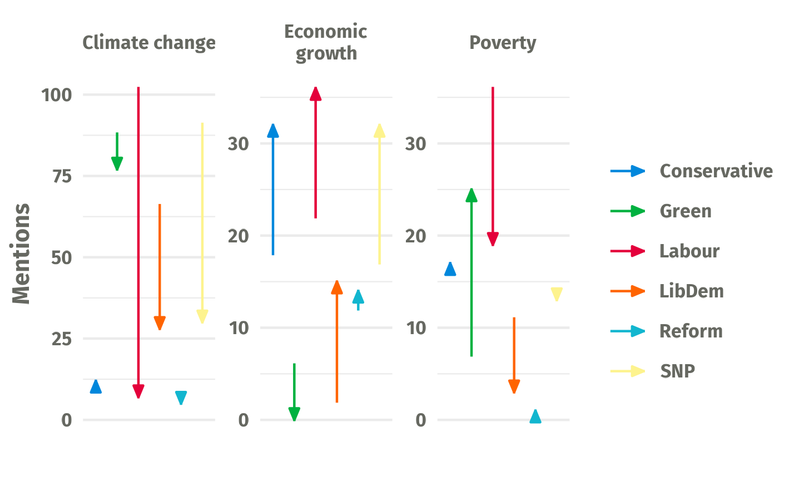
Note: we use text-mining techniques to count mentions, including conversion of words to their canonical forms (lemmas) to aid counting. Term-counting is as much an art as a science as it depends on judgement as to which terms to include under a heading. Here, climate change covers terms including “climate”, “net zero”, “carbon”, “emissions”, “decarbonisation” and “low carbon”. Poverty includes “poverty” and “deprivation”. Economic growth includes all mentions of “growth” other than those clearly referring to something other than economic growth (e.g. population growth). We analyse all mentions, rather than e.g. the length of sections covering particular topics, in order to pick up the extent to which an issue is embedded across the whole manifesto.
It’s the economy
The seriousness with which the parties address the interconnected issues around the Scottish budget, the economy and public services spans quite a range. At one end Reform present confusing arithmetic, purporting to show that the year-one reduction in Scottish revenues from cutting income tax would be paid for more than four-times over by ten years of higher growth and higher tax revenues, but cite no econometric evidence to support the claim.
While most manifestos promise tax restraint or cuts, the Greens’ manifesto lays out specific tax increases. These are set against the suite of spending pledges in the manifesto, though the party has said the complexity of public finances means a “fully funded manifesto” is a misleading concept. While it is generally true that tax policy x never precisely matches spending pledge y, a strong manifesto at least gives a realistic sense of scale on either side of the equation. The IFS argue the Greens’ x’s are significantly outweighed by their y’s. This is a real problem given more revenue will be needed over coming years just to stand still on the Scottish government’s spending pledges.
Other manifestos lean heavily on growth to solve the fiscal challenge and more generally improve life in Scotland. For the Lib Dems, “fair economic growth is the only credible way out of the cost-of-living crisis,” while for Labour, “sustained economic growth is the key route to improving living standards, reducing poverty and bringing prosperity to all parts of our country.”
This is worrying. Low growth is not an outcome that Scottish (or UK) governments have simply tolerated, leaving low hanging fruit to be harvested. Economic growth has consistently been a priority, and the reality of how difficult it is to return to pre-crash levels has only slowly been appreciated. Most recently, the Scottish Fiscal Commission’s downgraded its assumptions for Scotland’s potential rate of productivity growth rate (down from 1.2 per cent in its 2025 forecasts to 0.9 in 2026’s). Manifestos promising growth that would reverse this, particularly over the course of one parliament, have to be convincing. Yet none of the manifestos present clear evidence grounded in the empirical realities of the Scottish economy, instead appealing to text-book relations between growth and taxes/ skills/ planning etcetera.
There is, as ever, a focus on the institutions of economic development. The Conservatives propose merging Scottish Enterprise, Skills Development Scotland and the Scottish National Investment Bank to form ‘Growth Scotland’ (which looks very much like the pre-2008 model). Labour proposes merging the enterprise agencies and establishing a ‘Board of Trade’ through which stakeholders will be engaged to inform government policy. The SNP doesn’t propose shifting the agency deckchairs but will establish a ‘National Council for Economic Growth’, a High Growth Unit (to identify and support firms with the potential for rapid growth) and a major projects office. It isn’t clear if the latter two will reside within core government departments or agencies.
Getting the institutional infrastructure right is important but it’s highly unlikely to affect the rate of economic growth over the course of the next Parliament. The last two decades have witnessed a lot of institutional tinkering and a perplexingly wide range of stakeholder bodies of varying longevity. It’s difficult to argue any of this had a discernible impact on economic performance. The manifestos lack sufficient detail to properly assess whether things are likely to be different this time round, but experience suggests we should be cautious in our expectations.
Cutting public bodies
Creating new organisations sits uncomfortably with another common theme in several of the manifestos, namely the determination to cut back on public bodies in Scotland. SNP, Conservative, Lib Dem and Labour manifestos all propose various mechanisms to declutter the quango landscape with cost savings promised or implied.
Quangos are easy to attack in part because of their diversity: Historic Environment Scotland, the Scottish Futures Trust and Quality Meat Scotland are and do very different things. Most people would be aware of the existence and function of few if any . The assertion that there are too many meets little resistance due to lack of sufficient knowledge about the landscape. . However, it is instructive that the Conservative manifesto, when casting around for quangos to cut, was only able to name three: the Scottish Land Commission (18 staff, £1.6m funding), Community Justice Scotland (46 staff, £3.9m funding) and Architecture and Design Scotland (20 staff, £1.8m funding).
The agreement that there are too many public bodies is built less on evidence their existence is wasteful and more on wider fiscal pressures. The parties’ allergy to quangos is part of a broader emerging consensus that the public sector in Scotland is “too big.”
We have argued this is a misperception, that growth in public sector employment is driven principally by growth in the need for public services, particularly health and care services as we go through the demographic shift to an older population. Yet ageing as a fiscal and economic issue is startlingly absent from the manifesto’s account of the challenges facing Scotland. Similarly, climate as an economic challenge (both the need for investment and the economic headwinds attendant on a changing climate) is receding from the political debate in Scotland (below). Growth features as something that must be revived, rather than a phenomenon we may have to learn to live with less of than we did in the noughties.
By not naming these ongoing issues, politics risks falling into dangerous scapegoating territory, with economic and fiscal problems blamed on a bloated public sector (when the reality is our public sector is reeling from covid, Brexit and austerity), on the excesses of the benefits system (when in reality the UK benefits are comparatively threadbare means meaning we miss out on the dynamism enjoyed by countries with better social protection) and, most worryingly of all, on migrants.
Where has climate policy gone?
There has been a dispiriting retreat from the consensus across 2021 manifestos that Scotland should play an ambitious role in the global fight against climate change. Fringe talking points, like Scotland being too small to make a difference, have found their way into the Conservative party’s manifesto, justifying scrapping the 2045 target and redirecting heat pump funding. Reform also propose scrapping the net zero target and would “rehabilitate North Sea gas as our primary energy system,” as if declining production were due to policy rather than geology.
While climate has become more politically polarised, this is not because progressive parties have set out more ambitious agendas. Indeed, the opposite appears to be the case. This can be seen in the number of times climate change appears in 2021 and 2026 manifestos. This has fallen considerably for the Liberal Democrats, SNP and Labour. While the Greens saw a small fall theirs is, unsurprisingly, the 2026 manifesto that says most about climate.
The retreat from climate is also apparent in the way the parties talk about the issue. Taking the SNP as an illustrative example, in 2021 their manifesto was “proud to have the most ambitious legal framework for emissions reduction in the world,” foresaw “transformational actions,” and promised to “invest record amounts in tackling the climate crisis.” In 2026 these lofty ambitions have been replaced with the managerial “We will take the necessary action to achieve net zero,” and reiterates the misleading line that “Scotland is now more than halfway to net zero” (emissions are down more than 50 per cent, but this is a far cry from half the work needed to decarbonise having been done – shutting coal fired power stations is a very different challenge to preparing our homes for a future without gas).
There are various proposals scattered across the manifestos to tackle the efficiency and emissions from heating homes, with the Liberal Democrats arguably presenting proposals to tackle the widest range of barriers to increased deployment. The foregrounding of retrofit across manifestos is positive given how slowly the transition to clean heat is progressing. However, none of the manifestos engage seriously with the cost of rejuvenating our building stock and preparing it for a future without gas – the most significant fiscal pressure associated with devolved climate mitigation. Parties should be thinking explicitly about how to handle these costs in a way that is fair.
The manifestos of parties in favour of climate action tend to promise clear plans without giving detail or addressing trade-offs this would imply. For example, the Liberal Democrats want to reverse the decline in livestock numbers (the CCC advised a balanced pathway to net zero would include their reduction by around a third) but give no indication of how the increase in emissions would be offset.
Such failures to engage with distributional questions or the trade-off between climate and other objectives does not bode well for the next Parliament turning around stalled progress on emissions reductions.
Anti-poverty policy needs a fresh boost
Scotland has child poverty targets for 2030 which are widely expected to be missed. Across the manifestos we see little indication of policy agendas that rise to this challenge. The Conservative manifesto endorses the targets but argues they will be missed because the Scottish government sees more spending on benefits as the only way out of poverty. This would be replaced by more employment support. This binary framing between benefits and work unhelpfully ignores the extent of in-work poverty (which accounts for three quarters of child poverty). Our analyses last year showed that while employability can be an important route out of poverty for many families, it has real limits as a policy to bring the overall child poverty rate down – social security will have to play a larger role alongside employment if the statutory targets are to be hit.
The Green manifesto sets out a range of benefit policies, including higher levels, a double-lock on benefits supporting children, and auto-enrolment. While higher benefits are likely necessary components in any package powerful enough to eradicate child poverty, the fiscal implications need to be set out as argued above. A stronger offering would quantify the extent to which households would need to contribute, particularly those moderately well off not just the super-wealthy.
Labour and SNP manifestos both give the impression of tinkering around the edges of anti-poverty policy. The Scottish government has a good record and should rightly be proud of the introduction of the Scottish Child Payment, but the targets won’t be met resting on these laurels. The SNP pledge to extend childcare support from nine months to the end of primary is laudable but lacks definition – how much support will be made available is not spelled out. Labour plan to increase the value of tax-free childcare (a scheme where the UK government adds £2 for every £8 spent on childcare, up to a cap of £2,000), though again the manifesto is unclear on details (is this adding £3 for every £8 or just lifting the cap to £3,000?). Beyond that, Labour’s approach to child poverty is wrapped up in more general affordability pledges and promises of continuity on tax and benefits policies.
As with climate, the manifestos present a thin policy prospectus for achieving change across a complex system. Poverty in Scotland has many faces, not a single cause, and the transition to net zero means coordination and trade-offs. What is so disappointing about the manifestos is the absence of a system-wide analysis that’s needed to address these problems and persuade voters of the need to share their costs fairly.