Constructive coalitions? What the election means for the seventh session of the Scottish parliament
Article
What do the results of the 2026 Scottish parliament election tell us about how Scottish politics is changing? What do progressive parties need to do to get back on track?
In terms of the political makeup of the parliament, arguably little has changed: the SNP still lack a majority but continue to hold the dominant position; to their right sits a block of about 30 MSPs; and on the progressive side the SNP faces three smaller parties with which it might seek to do business.
But beneath the broad continuity in parliamentary arithmetic lies a worrying change in voter behaviour, with non-voting up by more than 10 points reaching 46.7 per cent of the electorate. To analyse this, we examine parties’ turnout (the proportion of the electorate voting for them) rather than their vote share.
The Greens, Labour and the Liberal Democrats each saw their list turnout change 2.8 percentage points or less, and collectively their turnout changed by just 1.3 points (1.7 on constituency votes).
Reform and the Conservative party saw more significant turnout changes, but as these were in the opposite direction, and because voter flows from Conservative to Reform are strong, it makes sense to consider their vote together. The share of the electorate willing to vote for right wing parties barely changed, increasing by just 0.3 percentage points on the list (0.8 points across constituency votes).
The party that saw the biggest change in the share of the electorate willing to vote for them was the SNP, falling 11.1 percentage points on the list (9.9 points on the constituency vote). The SNP’s falling vote was the main driver of falling turnout (down 10.2 points on the list and 10.3 points on constituency votes).
Figure 1: The fall in SNP vote was the biggest change affecting turnout
Change in turnout (list votes as a share of the registered electorate) across parties from the 2021 to 2026 Scottish parliament elections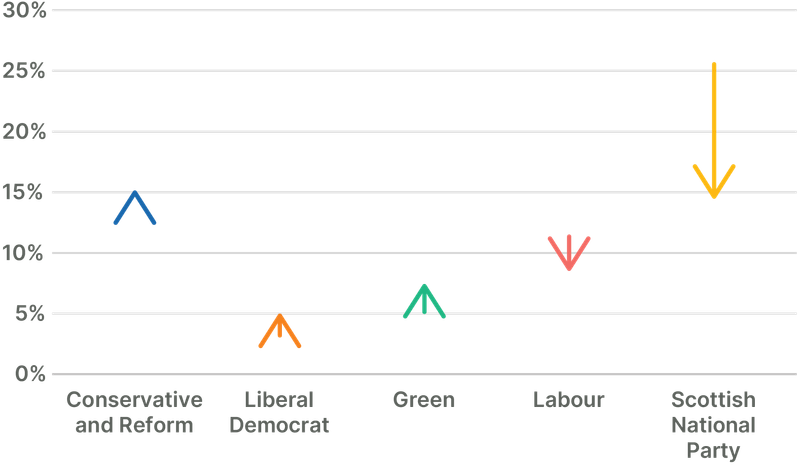
Source: Author’s analysis of vote and electorate counts from Wikipedia
What does this show? It supports a view that, coming out of covid in 2021, the parties managed to rouse more people than ever to vote in a Scottish parliament election, but the party system has failed to build on that momentum. Most parties have not hugely changed in their ability to mobilise voters – the governing party has clearly lost supporters, the other progressive parties have seen some minor shuffling but little to write home about. If there is a right-block in the electorate, these results don’t show it has grown significantly.
Clearly, the progressive parties’ efforts during the campaign to mobilise electors behind them were not a collective success. What went wrong?
To explore this, we draw on opinion polling commissioned by independent research group, Persuasion UK. The polling, conducted by YouGov, surveyed 1,603 adults in Scotland ahead of the election, between 24 April and 5 May, 2026.
The online poll asked whether people prefer governments that deliver for them specifically, or that reflect their values. It found a general preference for values alignment over a transactional relationship with government by a margin of 54 to 36 per cent - a difference of 18 points. Among supporters of the SNP, Labour, Lib Dems and Greens the margin is even bigger: 63 per cent to 31 per cent - a difference of 32 points.
Figure 2: People in Scotland want government to reflect their values
Which of these come closer to describing what sort of government you would prefer in the UK? 1 - I would prefer a government that fixes issues that impact my day-to-day life, even if I disagree with their values … 4 - I would prefer a government that reflects my values, even if I might not personally benefit in my day-to-day life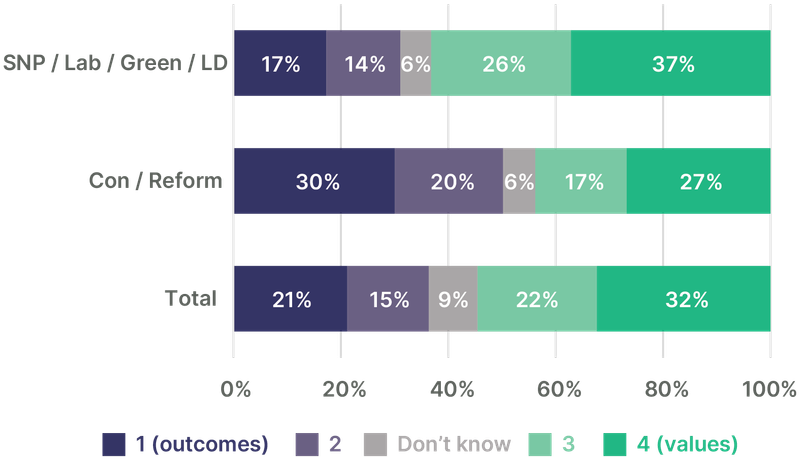
Source: IPPR analysis of Persuasion UK polling. In this and following figures, respondents are identified with parties by their constituency voting intention. 'Total' includes respondents who didn’t indicate an intention to vote for one of the six main parties.
While party manifestos always proclaim a set of values, the parties manifestos generally lacked anything substantive in this space. From promises to cut energy bills by a third or to keep taxes down, progressive parties generally leant into a transactional framing. In place of a coherent account of a good society to build towards, the manifestos tended toward shopping lists of measures designed to appeal to specific constituencies’ own interests.
To make this concrete, one of the most significant and least transactional issues of current times is climate change. While some climate policies are win-win, improving local prosperity while contributing to solving a global problem, this is not so for the entirety of the pathway to net zero. In narrow cost terms, difficult problems like retrofitting clean heat do not pay for themselves. Yet the majority in Scotland support the net zero target, with supporters of SNP, Labour, Lib Dems and Greens together showing 77 per cent support for net zero targets, compared with 61 per cent across the population and 25 per cent among Conservative and Reform voters.
Figure 3: Scottish opinion supports the transition to net zero, with minority opposition concentrated among voters for the Conservative and Reform parties
Do you support or oppose the UK’s target of becoming net zero by 2050?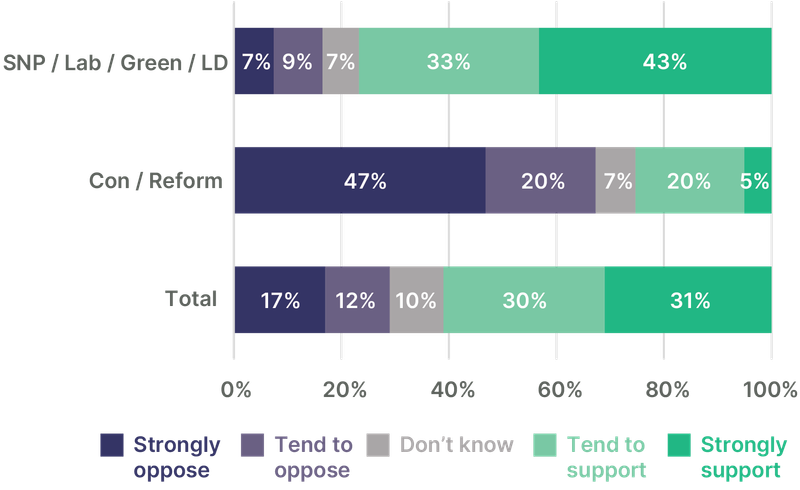
Source: IPPR analysis of Persuasion UK polling
Where climate did appear in the election debate it was framed as a choice between net zero targets and extracting oil and gas from the North Sea. Much of the debate ignores how depleted our oil and gas fields already are. Nonetheless, the issues ranked sixth (north sea industries) and seventh (climate) as shaping people’s vote choice. However, this ranking is significantly skewed by the preferences of Reform and Conservative voters. Stripping those out and focusing on SNP, Labour, Liberal Democrat and Green voters, the pattern is reversed, with 18 per cent listing climate and environment against 10 per cent selecting the future of North Sea oil and gas.
Figure 4: Progressive voters place more emphasis on climate than the future of the oil and gas industry in deciding who to vote for
Which of the following, if any, are MOST likely to shape your vote at the Scottish parliament election, if you do vote? Please select up to three options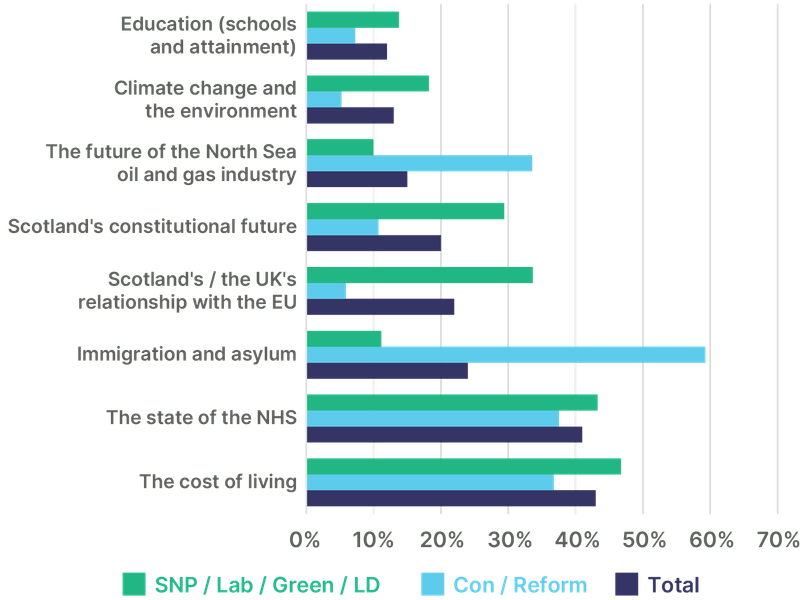
Source: IPPR analysis of Persuasion UK polling
It is remarkable that climate was the fifth most selected issue among progressive voters, given the crowded landscape of issues, including the cost of living and the place of Scotland in both the UK and in Europe. Across voter groups, the state of the NHS was highlighted as significant to people’s votes.
This is also reflected in what people see as explaining the problems Scotland faces. There is a shared view across supporters of progressive and right-wing parties that public services have been run down and that this is a major explanation of our problems. And yet, the election debate carried a near consensus across the parties that the public sector has become unwieldy and must be cut back – a proposition that our analysis suggests can only damage public services.
Figure 5: Across voter groups, there is a consensus that run down public services explain the problems Scotland faces, while other issues are more contested
What do you think best explains the problems facing Scotland at this time? Please select up to three options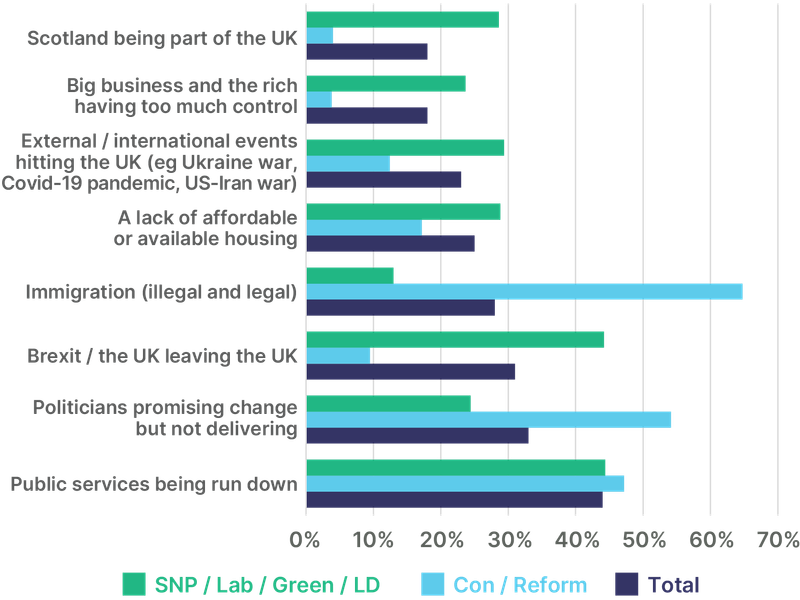
Source: IPPR analysis of Persuasion UK polling
These results paint a worrying picture of disconnection between progressive parties and the electorate. This is not because of a turn to the right among the electorate, but because progressive parties just haven’t done enough to grow their vote since 2021, with the SNP seeing it fall.
Progressive parties should use the seventh session of the Scottish parliament to turn that ship around, building values-led policy programmes. They must recognise the risk of drifting away from their voters on the critical issues of climate and public services. This will not be easy. On the one hand the fiscal gap cannot be wished away. But on the other, public services need adequate resource if they are not to deteriorate, and climate change is set to accelerate global stressors like food prices. These issues will become more pressing in Scotland over the next five years. The weak turnout at the 2026 election should be a wake-up call. Progressive politics in Scotland needs to step up.
Related items

Allies for delivery: Rebuilding faith in Scottish politics via the North Sea
Can Scottish politicians still build enough of a consensus to deliver meaningful change for disillusioned voters?
Rebuilding Scotland's "New Politics": a constructive parliament to build trust in Scottish politics
Political disillusionment is growing in Scotland, and policy is not delivering. MSPs who did not stand for re-election this year share how the parliament currently works and could be improved.
Wildfires and climate change | Dave Hawkey from IPPR Scotland speaks to Lewis Goodall on LBC
Europe’s heatwaves and the wildfires in the Cairngorms are a stark reminder that climate extremes are here. The Scottish government must act now with a clear plan to prepare for what's coming.